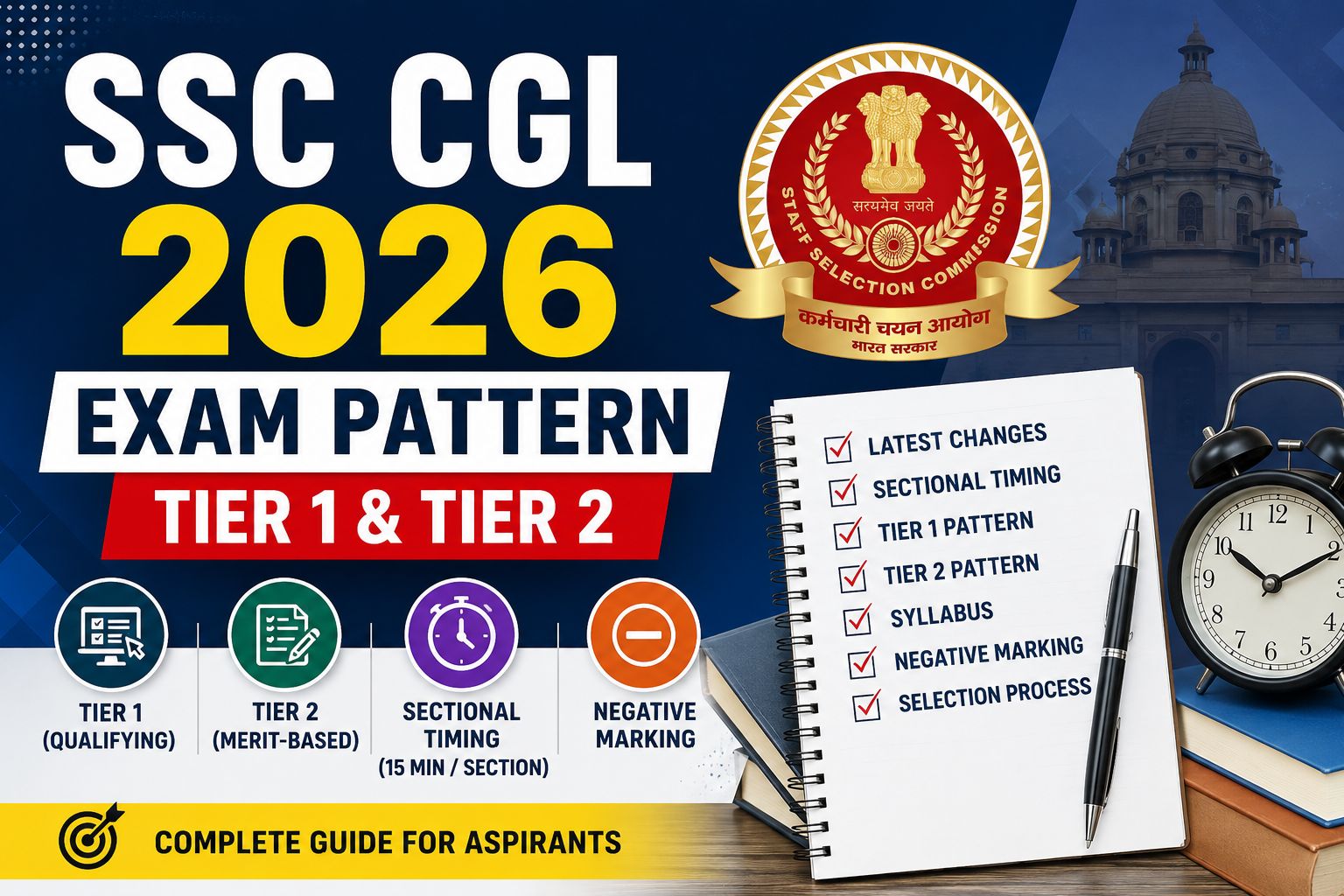
If you are preparing for SSC CGL 2026, understanding the latest exam pattern is the first step toward success. The Staff Selection Commission has introduced some important changes in SSC CGL 2026, including sectional timing, which has changed the way aspirants need to approach the examination. Many candidates are confused about whether Tier 1 marks are counted, how Tier 2 works, negative marking, sectional timings, and which papers are compulsory.
This detailed guide covers every major aspect of the SSC CGL 2026 Exam Pattern so that you don’t need to search elsewhere.
SSC CGL 2026 Selection Process
The SSC CGL 2026 recruitment process consists of:
Stage 1: Tier 1 (Qualifying)
Candidates must clear Tier 1 to become eligible for Tier 2.
Stage 2: Tier 2 (Merit-Based)
Final selection is based mainly on Tier 2 performance.
In simple words:
Tier 1 = Qualifying Stage
Tier 2 = Rank Deciding Stage
Document Verification
Final Selection
SSC has notified around 12,256 vacancies for various Group B and Group C posts.
SSC CGL Tier 1 Exam Pattern 2026
Tier 1 is conducted in online Computer Based Test (CBT) mode.
Subject Questions Marks
| SUBJECT | No. of Questions | Marks |
|---|---|---|
| General Intelligence & Reasoning | 25 | 50 |
| General Awareness | 25 | 50 |
| Quantitative Aptitude | 25 | 50 |
| English Comprehension | 25 | 50 |
| Total | 100 | 200 |
Duration
Total Time: 60 Minutes
New Sectional Timing: 15 Minutes for each section
This is one of the biggest changes in SSC CGL 2026. Once 15 minutes for a section ends, candidates automatically move to the next section and cannot return.
Marking Scheme
Correct Answer: +2 Marks
Wrong Answer: -0.50 Marks
Unattempted: 0 Marks
Major Change in SSC CGL 2026: Sectional Timing
Previously, candidates could freely move between sections during the exam.
Now SSC has introduced:
15 minutes for Reasoning
15 minutes for General Awareness
15 minutes for Quantitative Aptitude
15 minutes for English
This means:
✔ Time management becomes more important.
✔ You cannot compensate later if you waste time in one section.
✔ Every section must be practiced separately.
Many aspirants consider this the biggest change in SSC CGL 2026.
Is Tier 1 Qualifying or Merit-Based?
This is the most common doubt among aspirants.
Answer:
Tier 1 is qualifying in nature.
Its primary purpose is to shortlist candidates for Tier 2.
However, scoring high in Tier 1 is still important because cutoff marks determine whether you qualify for the next stage.
SSC CGL Tier 2 Exam Pattern 2026
Tier 2 is the most important stage because final merit is prepared using Tier 2 scores.
Paper I is compulsory for all candidates.
Additional papers are conducted only for specific posts.
Tier 2 Paper I (Compulsory for Everyone)
Paper I is divided into multiple sections.
Section I
Mathematical Abilities
30 Questions
Reasoning & General Intelligence
30 Questions
Section II
English Language & Comprehension
45 Questions
General Awareness
25 Questions
Section III
Computer Knowledge Test
20 Questions
Session II
Data Entry Speed Test (DEST)
Candidates must type approximately 2000 key depressions within the given time.
DEST is qualifying in nature.
Tier 2 Paper II
Applicable only for:
Junior Statistical Officer (JSO)
Statistical Investigator Grade-II
Pattern
100 Questions
200 Marks
2 Hours Duration
Tier 2 Paper III
Applicable only for:
Assistant Audit Officer (AAO)
Assistant Accounts Officer (AAO)
Subject
General Studies (Finance & Economics)
Pattern
100 Questions
200 Marks
2 Hours Duration
Negative Marking in SSC CGL Tier 2
Many aspirants lose marks due to excessive guessing.
Paper I
Wrong Answer: -1 Mark in major sections
Paper II & III
Wrong Answer: -0.50 Marks
Therefore, blind guessing can significantly reduce your score.
Which Subjects Require Maximum Attention?
Based on previous trends and the latest pattern:
High-Scoring Sections
English
Reasoning
Rank-Deciding Sections
Quantitative Aptitude
General Awareness
Most toppers recommend strengthening Maths because it creates the biggest score difference among candidates.
SSC CGL 2026 Preparation Strategy According to New Pattern
1. Practice Section-Wise Mocks
Because of sectional timing, solving full papers alone is not enough.
Practice:
15-minute Reasoning Tests
15-minute English Tests
15-minute GA Tests
15-minute Maths Tests
2. Focus More on Speed
The new pattern rewards candidates who can quickly identify easy questions.
3. Avoid Guesswork
Negative marking can reduce your score drastically.
Attempt only questions where you have reasonable confidence.
4. Improve Computer Knowledge
Many candidates ignore the Computer Knowledge module.
Since it is compulsory, basic computer concepts should be covered thoroughly.
5. Regular Mock Analysis
Taking mocks is important.
Analyzing mistakes is even more important.
Maintain a notebook for:
Calculation mistakes
Concept mistakes
Silly errors
Frequently Asked Questions (FAQs)
Is SSC CGL 2026 Tier 1 qualifying?
Yes. Tier 1 is qualifying in nature and is used to shortlist candidates for Tier 2.
Is there sectional timing in SSC CGL 2026?
Yes. SSC has introduced sectional timing for Tier 1, giving 15 minutes to each section.
How many questions are there in Tier 1?
100 Questions for 200 Marks.
What is the negative marking in Tier 1?
0.50 marks are deducted for every incorrect answer.
Is Tier 2 compulsory?
Yes. Tier 2 is compulsory and decides the final merit ranking.
Which paper is compulsory in Tier 2?
Paper I is compulsory for all candidates.
Conclusion
SSC CGL 2026 has become more competitive with the introduction of sectional timing. Aspirants can no longer rely solely on overall speed; they must perform efficiently in every section within the allotted time. Tier 1 remains a qualifying stage, while Tier 2 determines final selection. Candidates who focus on Maths, English, Computer Knowledge, and sectional mock practice will have a significant advantage.
With more than 12,000 vacancies and a revised exam pattern, SSC CGL 2026 presents a major opportunity for graduates aiming for prestigious central government jobs. The key to success is understanding the pattern early, preparing strategically, and practicing consistently.