
Karnataka State Police Constable (Civil) Direct Recruitment 2026: Complete Guide for Aspirants

ALT TEXT: Karnataka Police Constable Recruitment 2026 notification with online application start date June 8 and civil police constable vacancies

 Karnataka Police Constable Recruitment 2026: Golden Opportunity for Government Job Seekers

The Karnataka State Police (KSP) Department has announced a major recruitment drive for Police Constable (Civil) posts in 2026, creating a significant opportunity for candidates aspiring to serve the state and build a stable government career. Every year, thousands of young men and women prepare for police recruitment examinations, and the Karnataka Police Constable Direct Recruitment 2026 is expected to attract a large number of applicants from across the state.

For candidates who dream of wearing the khaki uniform and contributing to public safety, this recruitment drive offers a direct pathway into one of Karnataka’s most respected government departments. With attractive salary packages, job security, promotion opportunities, and social prestige, the Police Constable (Civil) position remains one of the most sought-after government jobs in Karnataka.

About Karnataka State Police Department

The Karnataka State Police Department is responsible for maintaining law and order, preventing crime, ensuring public safety, and protecting citizens throughout the state. Operating under the Home Department of the Government of Karnataka, the police force plays a vital role in ensuring peace and security.

Police Constables serve as the backbone of the department. They perform field duties, assist senior officers during investigations, manage crowd control, enforce laws, and support various public safety initiatives.

Karnataka Police Constable (Civil) Recruitment 2026 Overview

The Karnataka Police Constable (Civil) Direct Recruitment 2026 aims to fill a large number of vacancies across various districts and police units in Karnataka. The recruitment process is expected to be conducted through a transparent and merit-based selection system.

Key Highlights

Organization: Karnataka State Police (KSP)
Post Name: Police Constable (Civil)
Job Location: Karnataka
Application Mode: Online (KEA website)
Category: State Government Job
Selection Process: Written Examination, Physical Tests, Document Verification, and Medical Examination
Salary: As per Karnataka Government pay scale and allowances (ranges from ₹37,500 to ₹76,100 per month)
Eligibility: PUC/12th Pass or equivalent qualification


Important Dates

  • Notification Release Date: June 2026
  • Online Application Start Date: 08 June 2026
  • Last Date to Apply: 03 July 2026
  • Exam Date: 02 August
  • Admit Card Release: To Be Announced


Important Links

Karnataka Police Constable (Civil) Vacancy Details 2026

RPC / Non-Kalyana Karnataka (NHK): 3,395 Posts
Kalyana Karnataka (HK/KK): 596 Posts

Total: 3,991 Posts

Educational Qualification

Candidates applying for Karnataka Police Constable (Civil) Recruitment 2026 should have completed:

PUC (12th Standard) from a recognized board, or
Equivalent educational qualification recognized by the Government.

Applicants should carefully verify the official notification for specific educational requirements before applying.

Age Limit

The age criteria generally vary according to category reservations.

Typical age requirements include:

Minimum Age: 19 years
Maximum Age: 25 years for General Category
Age relaxation for SC, ST, OBC, and other reserved categories as per Karnataka Government rules

Candidates should refer to the official notification for exact age calculations and category-wise relaxations.

Selection Process for Karnataka Police Constable

The Karnataka Police Constable (Civil) selection process is designed to evaluate both academic knowledge and physical fitness.

1. Written Examination

The written examination usually tests candidates on:

* General Knowledge
* Current Affairs
* Indian Constitution
* Karnataka History and Geography
* Reasoning Ability
* Mental Ability

Candidates should regularly read newspapers and practice mock tests to improve their performance.

2. Physical Standard Test (PST)

Applicants must satisfy prescribed physical standards such as:

* Height requirements
* Chest measurements (for male candidates)
* Weight and physical fitness standards

The standards may vary based on category and reservation rules.

3. Endurance Test (ET)

Physical endurance is a crucial requirement for police service. Candidates are expected to participate in running and other fitness-related activities to demonstrate stamina and physical capability.

 4. Document Verification

Candidates who clear the written and physical tests must submit original documents for verification.

Required documents generally include:

* SSLC Marks Card
* PUC Marks Card
* Aadhaar Card
* Caste Certificate (if applicable)
* Income Certificate (if applicable)
* Passport-size Photographs

5. Medical Examination

The final stage involves a medical fitness test conducted by authorized medical professionals to ensure candidates are physically fit for police service.

Karnataka Police Constable Salary and Benefits

One of the major attractions of Karnataka Police jobs is the competitive salary structure.

Selected candidates receive:

* Basic Pay
* Dearness Allowance (DA)
* House Rent Allowance (HRA)
* Travel Allowance (TA)
* Medical Benefits
* Pension and Retirement Benefits as per government rules
* Promotion Opportunities

Apart from financial benefits, police personnel enjoy social respect and long-term job security.

How to Apply for Karnataka Police Constable Recruitment 2026

Candidates can apply online by following these steps:

1. Visit the official Karnataka Examination Authority (KEA) website.
2. Open the Police Constable (Civil) Recruitment 2026 notification.
3. Read all instructions carefully.
4. Complete the online registration process.
5. Fill in personal, educational, and communication details.
6. Upload required documents and photographs.
7. Pay the application fee, if applicable.
8. Submit the application form.
9. Download and print the application confirmation page.

Applicants should keep copies of all submitted documents for future reference.

Preparation Tips for Karnataka Police Constable Exam 2026

Competition for police jobs is increasing every year. Candidates should begin preparation early.

Study Strategy

* Follow a daily study schedule.
* Focus on Karnataka General Knowledge.
* Read current affairs regularly.
* Practice reasoning questions.
* Solve previous years’ question papers.

Physical Fitness Preparation

* Practice daily running.
* Improve stamina through regular exercise.
* Maintain a healthy diet.
* Follow a disciplined fitness routine.

Consistent preparation can significantly improve the chances of success.

Why Choose a Career in Karnataka Police?

Joining Karnataka Police is more than securing a government job. It provides an opportunity to serve society, protect citizens, and contribute to public welfare. Police personnel gain valuable experience, leadership skills, and career growth opportunities throughout their service.

For young aspirants looking for a respected and rewarding profession, the Karnataka Police Constable (Civil) Recruitment 2026 offers an excellent career path.

Final Words

The Karnataka Police Constable (Civil) Direct Recruitment 2026 presents a promising opportunity for candidates seeking government employment in Karnataka. With a structured selection process, attractive salary package, and long-term career prospects, this recruitment drive is expected to attract thousands of applicants.

Interested candidates should regularly monitor official recruitment announcements, prepare thoroughly for the written examination and physical tests, and submit their applications before the deadline. A disciplined approach, dedication, and consistent preparation can help aspirants achieve their dream of joining the Karnataka State Police force.
​RRB ALP Notification 2026 Out: Check 11,127 Vacancies, Exam Dates, Eligibility, and How to Apply Online

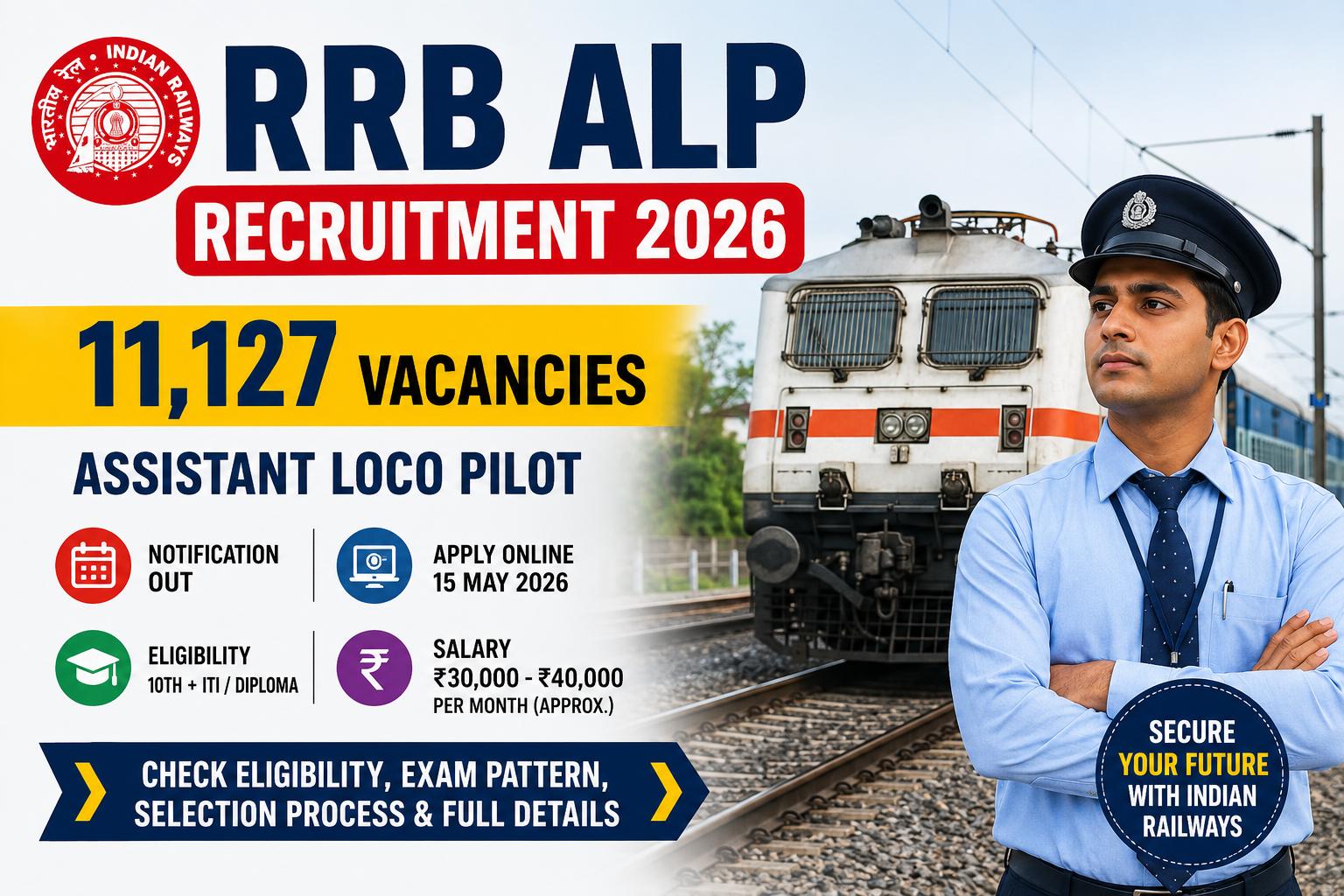
RRB ALP Recruitment 2026 notification showing 11127 Assistant Loco Pilot vacancies in Indian Railways with eligibility, salary and application details.

​The Ministry of Railways, via the Railway Recruitment Boards (RRBs), has officially released the detailed Centralised Employment Notice (CEN) No. 01/2026 for the recruitment of Assistant Loco Pilot (ALP). This year, the Indian Railways has announced a massive wave of opportunities with 11,127 vacant positions across various railway zones.
​For lakhs of government job aspirants with a technical background, this is one of the most highly anticipated recruitment drives of the year. If you dream of operating locomotives and building a stable, high-growth career with the Indian Railways, now is the time to act.
​This comprehensive guide breaks down everything you need to know about the RRB ALP 2026 Notification, including important dates, eligibility criteria, zone-wise vacancies, selection process, exam pattern, and step-by-step application instructions.

What is RRB ALP?

The full form of ALP is Assistant Loco Pilot. An ALP works under the Loco Pilot and helps in operating trains safely and efficiently. It is one of the most popular technical jobs in Indian Railways.
The recruitment is conducted by the Railway Recruitment Boards under the Ministry of Railways, Government of India.

RRB ALP Notification 2026 Overview

ParticularsDetails
Recruitment Name RRB ALP Recruitment 2026
Conducting Body Railway Recruitment Board (RRB)
Post Name Assistant Loco Pilot (ALP)
Job Location Across India
Job Category Central Government (Indian Railways)
Application Mode Online Only
Selection Process CBT 1, CBT 2, CBAT, Document Verification
Official Website Indian Railways RRB Portal
Notification Number CEN No. 01/2026
Total Vacancies 11,127 Posts
Pay Level Level 2 (7th CPC Pay Matrix)
Initial Pay Scale ₹19,900/- plus allowances


RRB ALP 2026 Important Dates

Notification Date: May 14, 2026

​​​Application Start Date: May 15, 2026
​Last Date to Apply : June 14, 2026 (up to 23:59 Hrs)
​Last Date for Application Fee Payment: June 16, 2026
​Application Correction/Modification Window: June 17, 2026, to June 26, 2026
​CBT 1 Exam Date: To be notified soon (Tentatively August 2026)

​Important Note: A candidate is permitted to apply to only one RRB zone, and only a single online application form per candidate will be accepted. Submitting multiple applications will lead to rejection.


RRB ALP Recruitment 2026: Important Links

​To help you save time, we have aggregated all the essential official links for the CEN No. 01/2026 recruitment cycle below. Ensure you only download notifications and apply through these authenticated government platforms:

Official Online Application Portal: https://www.rrbapply.gov.in

Download Official Detailed Notification PDF: https://www.rrbcdg.gov.in/uploads/2026/01-ALP/012026ALP-CEN.pdf

​Official Central Railway Website: https://indianrailways.gov.in/

Note: All RRB ZONE official links given last of this article 

Total Vacancies & Post Details

​The 11,127 vacancies are distributed across 21 regional Railway Recruitment Boards nationwide. These vacancies are split among various categories including General (UR), OBC (NCL), SC, ST, and EWS. The detailed zone-wise break-up is made available in Annexure-B of the official PDF notification on regional RRB web portals (such as RRB Ajmer, RRB Chandigarh, RRB Secunderabad, etc.).


Eligibility Criteria for RRB ALP 2026

​To clear the scrutiny stage, candidates must fulfill the strict age, educational, and medical eligibility requirements laid down by the Ministry of Railways.

​1. Educational & Technical Qualification

​Candidates must possess Matriculation/SSLC (Class 10th pass) along with one of the following technical qualifications from a recognized institute (NCVT/SCVT):

​ITI (Industrial Training Institute) Certification in relevant trades such as Fitter, Electrician, Instrument Mechanic, Millwright/Maintenance Mechanic, Mechanic (Radio & TV), Electronics Mechanic, Mechanic (Motor Vehicle), Wireman, Tractor Mechanic, Armature & Coil Winder, Mechanic (Diesel), Heat Engine, Turner, Machinist, or Refrigerator & AC Mechanic.

​Diploma in Engineering: A 3-year Diploma in Mechanical, Electrical, Electronics, or Automobile Engineering.

​Degree in Engineering: A B.E. or B.Tech degree in the branches specified above in lieu of an ITI or Diploma.

​2. Age Limit (As of July 1, 2026)

​The basic age limit for the unreserved categories is 18 to 30 years. However, age relaxations are applicable for reserved categories according to government guidelines:

​OBC (Non-Creamy Layer): Upper age relaxation up to 33 years.

SC / ST: Upper age relaxation up to 35 years.

​Ex-Servicemen: As per prevailing Railway guidelines.

​3. Medical Standards (A-1 Category)

​The Assistant Loco Pilot role demands exceptional physical fitness, especially regarding eyesight. Candidates must meet the A-1 Medical Standard:

​General Fitness: Physically fit in all aspects.

​Distant Vision: 6/6, 6/6 without glasses (Lens/spectacles are strictly prohibited).

​Near Vision: Sn. 0.6, 0.6 without glasses.

Must Pass Tests For: Color Vision, Binocular Vision, Field of Vision, Night Vision, and Mesopic Vision.


RRB ALP Selection Process 2026

​Cracking the RRB ALP exam requires clearing 5 distinct phases. The continuous evaluation ensures that only mentally and physically competent individuals operate high-speed trains.

First Stage (CBT-1): This acts as a screening/filtering layer. Marks scored in CBT-1 are not counted toward final merit calculation.

​Second Stage (CBT-2): Candidates 15 times the number of vacancies per RRB zone will be shortlisted for CBT-2 based on their CBT-1 performance.

​CBAT (Psycho Test): Only for those who qualify the core sections of CBT-2.

​Document Verification & Medical Exam: The final checks before generating the appointment letter.


Exam Pattern & Marking Scheme

​To strategize your preparation, you must thoroughly understand the blueprint of both online examinations.

CBT-1 Exam Pattern

​Total Questions: 75 Questions

​Total Duration: 60 Minutes (1 Hour)

​Negative Marking: 1/3rd of the assigned mark will be deducted for every incorrect response.

Sections: Mathematics, Mental Ability/Reasoning, General Science, and General Awareness on Current Affairs.

CBT-2 Exam Pattern

​CBT-2 is divided into two distinct parts conducted in a single session lasting 2 Hours and 30 Minutes for a total of 175 questions.

​Part A (100 Questions | 90 Minutes): Includes Mathematics, General Intelligence & Reasoning, and Basic Science & Engineering. Crucial note: Your performance in Part A forms the primary basis for shortlisting candidates for the CBAT phase.

​Part B (75 Questions | 60 Minutes): This is a qualifying test focusing entirely on your chosen relevant trade subject. Candidates must secure a minimum qualifying score of 35% in Part B to even have their Part A marks evaluated.


Regional RRB Websites (Zone-Wise Links)

​Candidates must apply to only one regional board. Use the official text links below to check specific localized updates, seat divisions, and admit card statuses:

RRB Ahmedabad: https://rrbahmedabad.gov.in/

​RRB Ajmer: https://rrbajmer.gov.in/

​RRB Bengaluru: http://www.rrbbnc.gov.in/

​RRB Bhopal: https://rrbbhopal.gov.in/

​RRB Bhubaneswar: https://www.rrbbbs.gov.in/

​RRB Bilaspur: http://rrbbilaspur.gov.in/

​RRB Chandigarh: https://www.rrbcdg.gov.in/

​RRB Chennai: https://rrbchennai.gov.in/

​RRB Gorakhpur: https://www.rrbgkp.gov.in/

​RRB Guwahati: https://www.rrbguwahati.gov.in/

​RRB Jammu-Srinagar: https://www.rrbjammu.nic.in/

​RRB Kolkata: https://www.rrbkolkata.gov.in/

​RRB Malda: https://rrbmalda.gov.in/

​RRB Mumbai: https://www.rrbmumbai.gov.in/

​RRB Muzaffarpur: https://rrbmuzaffarpur.gov.in/

​RRB Patna: https://www.rrbpatna.gov.in/

​RRB Prayagraj (Allahabad): https://rrbpryj.gov.in/

​RRB Ranchi: https://www.rrbranchi.gov.in/

​RRB Secunderabad: https://rrbsecunderabad.gov.in/

​RRB Siliguri: https://www.rrbsiliguri.gov.in/

​RRB Thiruvananthapuram: https://www.rrbthiruvananthapuram.gov.in/

BEL Recruitment 2026: Apply Online for 56 Field Operation & Project Engineer Posts

BEL Project Engineer 2026 official notification featured image with Bharat Electronics building and apply online details.

Securing a job in a Navratna Public Sector Undertaking (PSU) under the Ministry of Defence is a dream for thousands of engineering graduates in India. Bharat Electronics Limited (BEL) has turned that dream into an immediate opportunity by releasing its official notification for the recruitment of Field Operation Engineers (FOE) and Project Engineer-I positions.

​If you are looking for a high-paying, stable career contributing directly to national security and tactical defense systems, this is your call to action.


​BEL Recruitment 2026 Overview

​This fresh recruitment cycle aims to fill 56 vacancies on a temporary/contract basis for BEL’s HLS&SCB Strategic Business Unit (SBU). Selected candidates will be deployed to critical project sites across Delhi, Punjab, Uttar Pradesh, and Madhya Pradesh.


​Here is a quick snapshot of the key highlights you need to know:

ParticularsDetails
Recruiting Authority Bharat Electronics Limited (BEL)
Post Names Field Operation Engineer & Project Engineer-I
Total Vacancies 56 Posts
Application Mode Online (Via Official Microsoft Office Form)
Online Registration Window May 20, 2026, to June 8, 2026
Job Nature Temporary / Contractual
Posting Locations Punjab, Uttar Pradesh, Madhya Pradesh, Delhi
Official Website bel-india.in


Post-Wise Vacancy and Salary Breakdown

​The recruitment drive offers competitive initial packages along with annual increments, travel allowances, and robust insurance coverage. The detailed distribution of posts and starting salaries includes:

​1. Field Operation Engineer (FOE)

​Total Vacancies: 25 Posts

Initial Remuneration: Rs. 60,000/- per month for the first year, featuring annual structural increments.

Additional Perks: Compulsory annual allowances of Rs. 12,000/- for attire, stitching, and footwear, coupled with institutional medical insurance.

2. Project Engineer-I

​Total Vacancies: 31 Posts

Initial Remuneration: Rs. 40,000/- per month for the first year, with sequential annual increments based on tenure extensions.


Strict Eligibility Criteria: Are You Eligible?

​To survive the initial screening process, your profile must strictly line up with the technical benchmarks specified by BEL.

Educational Qualifications

​Candidates must hold an AICTE/UGC-approved full-time degree from a recognized university in the following formats:

​B.E. / B.Tech / B.Sc Engineering (4-Year Course)

​M.E. / M.Tech

​MCA (Master of Computer Applications)


Eligible Engineering Disciplines

Electronics: Electronics & Communication, Electronics & Telecommunication, Telecommunication, Communication Engineering.

Mechanical: Core Mechanical Engineering fields.

Computer Science / IT: Cybersecurity, Computer Science, Information Technology, Information Science.


Age Limit & Required Experience (As of June 1, 2026)

​The recruitment requires specific industrial post-qualification experience. Academic project timelines or standard college internships do not count toward this experience requirement.

Field Operation Engineer: Maximum 40 years of age. Requires a minimum of 5 years of hands-on industrial experience in networking, data center operations, or database administration.

Project Engineer-I: Maximum 32 years of age. Requires a minimum of 2 years of relevant post-qualification industrial experience.

Age Relaxation Notice: Upper age limits are relaxed by 3 years for OBC (Non-Creamy Layer) candidates, 5 years for SC/ST candidates, and 10 years for PwBD categories.


Mandatory Global Certifications

​BEL mandates that applicants possess at least one basic or advanced-level OEM certification across specific domains:

Networking/Security: Cisco (CCNA/CCNP), Fortinet, Juniper, Extreme, Arista Networks, Palo Alto, FireEye.

Cloud/Storage/Systems: HPE, Hitachi, Dell, NetApp, SentinelOne, CrowdStrike.

Cybersecurity Frameworks: OSCP, CEH, CISA, CISM, CISSP, CompTIA.


Step-by-Step Application Process

​Unlike traditional recruitment drives that utilize standard third-party portals, BEL is receiving applications exclusively through an official Microsoft Office Form linked via their career portal.

Step 1: Review the Official Notification – Go to the official website at www.bel-india.in/careers and download the detailed PDF advertisement under the HLS&SCB SBU. Read through the specific skill alignments carefully.

Step 2: Process Application Fees via SBI Collect – Generate your application fee payment through SBI Collect online. Keep the unique SBI Collect Reference Number and transaction receipt handy, as this must be entered in the final form.

Step 3: Access the Designated Microsoft Form Link – Click on the specific Microsoft Office Form link provided in the careers section matching your intended post (either FOE or Project Engineer-I).

Step 4: Fill and Finalize the Application – Input your academic scores, personal details, certification numbers, and your SBI Collect reference ID accurately. Ensure all self-attested documents are compiled as required and submit the form prior to the closing date on June 8, 2026.


The Selection Procedure Explained

​Applications will be filtered strictly according to merit, academic consistency, and core industrial experience. The process follows a clear structure:

Online Application Screening: Initial filtering based on your submitted experience certificates and degrees.

Written Examination: Evaluates technical core knowledge corresponding to your engineering discipline alongside general aptitude.

Personal Interview: Shortlisted individuals from the written test will face a panel evaluating problem-solving speed and real-world deployment knowledge.

Document Verification & Medical Clearance: Final validation before onboarding.

​Make sure to double-check your application documents before submitting to avoid getting filtered out in the very first stage!


SSC CGL Notification 2026 Out: How to Apply Online at ssc.gov.in (Step-by-Step)

SSC CGL 2026 notification out for 12256 posts

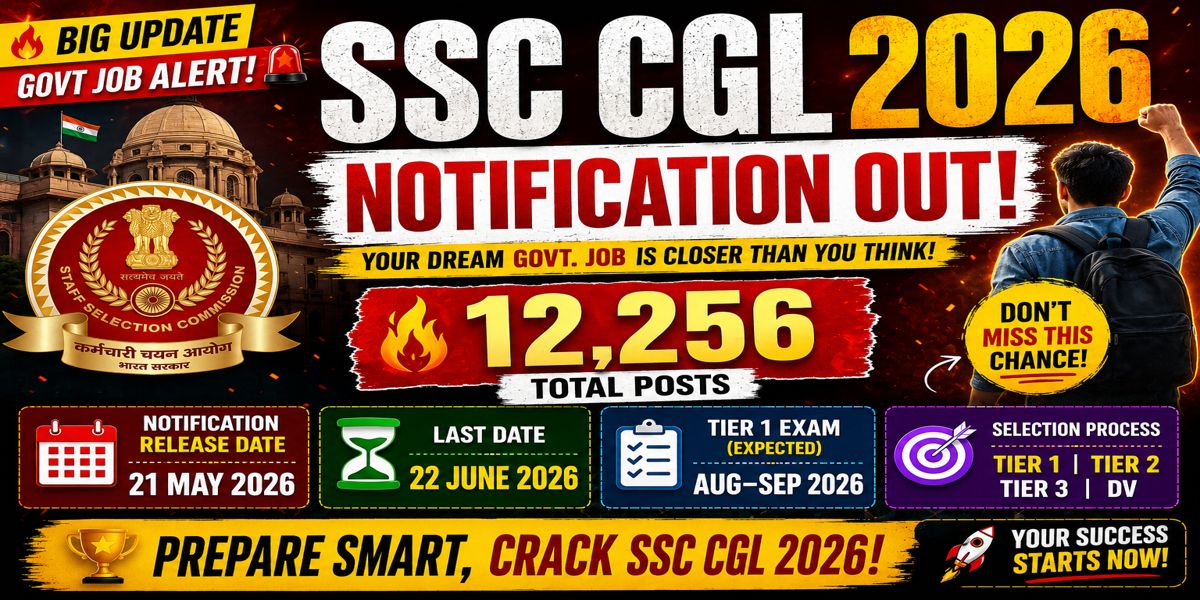
The wait is officially over! The Staff Selection Commission has dropped the mega bomb of the year: the SSC CGL 2026 Notification is officially OUT on the new portal (ssc.gov.in). If you’ve been dreaming of securing a high-profile, powerful Central Government job with a handsome salary and authority, your countdown starts right now.

​This year, SSC has announced a massive 12,256 tentative vacancies for elite Group B and Group C posts, including Income Tax Inspectors, ASOs in MEA, Central Excise Inspectors, and CBI Sub-Inspectors.

But wait—before you hit that “Apply Online” button, there is a catch. The 2026 notification isn’t just a copy-paste of previous years. SSC has quietly slipped in some massive structural changes in eligibility, Tier-2 paper formatting, and strict administrative rules that could reject your application or tank your score if you aren’t paying attention.

​Let’s break down every critical detail, the hidden traps, and your strategic roadmap to crack SSC CGL 2026.


🚀 SSC CGL 2026: Master Schedule & Crucial Dates

​Do not wait until the final week. The SSC server is notorious for crashing due to heavy traffic. Mark these dates on your calendar immediately:

Notification Release Date: May 21, 2026

Online Application Window: May 21, 2026 to June 22, 2026 (Till 11:00 PM)

Last Date for Online Fee Payment: June 23, 2026 (Till 11:00 PM)

Application Correction Window: June 29, 2026 to July 1, 2026

SSC CGL Tier-1 Exam Date: August – September 2026

​SSC CGL Tier-2 Exam Date: December 2026 (Tentative)

⚠️ Pro-Tip for Readers: Set a personal deadline of June 15th to complete your online form submission. The correction window charges an extra fee, so get it right the first time!


🔗Important Links

Apply Online: Click here

SSC CGL 2026 Notification PDF: Click here

Official Website: https://ssc.gov.in/

Join WhatsApp Channel : Click here 

Join Telegram Channel: Click here


​🔥 The Major Bombshells: What Changed in SSC CGL 2026?

​If you are preparing based on the old rules, you are heading blindly into danger. SSC has updated its playbook this year. Here are the major changes you need to know:

Tier-II Exam Restructuring: The exam structure has evolved with a clear shift towards explicit sectional timelines. For the prestigious Assistant Audit Officer (AAO) and Assistant Accounts Officer tracks, a dedicated Paper-III evaluation layout has been introduced to filter out non-serious applicants early.

Statistical Investigator Criteria Explodes: Earlier, this post was locked down for pure Statistics grads. This year, eligibility has expanded massively! If your graduation includes fields like Data Science, Artificial Intelligence (AI), Computer Science, or Information Technology (IT), you can now apply.

The 3-Year Document Trap: Under the new administrative rules, candidates are strictly instructed to preserve their dynamic application records, identity authentications, and certificates for up to 3 years from the date of the exam. Do not lose your registered printouts!

Age Reference Shift: The crucial date for determining your eligibility age limit has been fixed as August 1, 2026.


💰 Post Profiles, Pay Levels & Vacancy Trends

​Why is there so much hype around the Combined Graduate Level exam? It is all about the power, stability, and jaw-dropping salary packages. Let’s look at the elite posts available under the 12,256 vacancies announced this year:

Pay Level 8 (Rs. 47,600 to Rs. 1,51,100): Assistant Audit Officer, Assistant Accounts Officer (The only Gazetted posts).

Pay Level 7 (Rs. 44,900 to Rs. 1,42,400): Inspector of Income Tax, Inspector (Central Excise), Assistant Section Officer (ASO) in MEA, IB, and CSS.

Pay Level 6 (Rs. 35,400 to Rs. 1,12,400): Sub-Inspector in CBI, Junior Statistical Officer (JSO), Divisional Accountant.

Pay Level 4 & 5 (Rs. 25,500 to Rs. 92,300): Auditor, Accountant, Tax Assistant, Senior Secretariat Assistant.


📉 Looking at the Reality Check: Vacancy Trends Over the Years

​While 12,256 is an incredible number, it is slightly lower than last year. This means competition will be razor-sharp. There is absolutely no room for casual preparation.

2026: 12,256 vacancies

2025: 15,118 vacancies

2024: 17,727 vacancies

2023: 8,415 vacancies


🎯 Cracking the Code: The Exam Pattern Explained

​The recruitment process consists of two primary online testing phases: Tier-1 and Tier-2, entirely eliminating the old interview system.

1. Tier-1 Examination (Qualifying Nature)

​You have 60 minutes to tackle 100 questions. Remember, there is a penalty of 0.50 marks for every wrong answer.

General Intelligence & Reasoning: 25 Questions (50 Marks)

General Awareness: 25 Questions (50 Marks)

Quantitative Aptitude: 25 Questions (50 Marks)

English Language & Comprehension: 25 Questions (50 Marks)


2. Tier-2 Examination (The Ultimate Merit Maker)

​This is where your final ranking is decided. It is broken down into separate mandatory modules:

Section I: Mathematical Abilities (30 Qs) + Reasoning & General Intelligence (30 Qs) — Time: 1 Hour

Section II: English Language (45 Qs) + General Awareness (25 Qs) — Time: 1 Hour

Section III: Computer Knowledge Module (20 Qs) + Data Entry Speed Test (DEST) — Qualifying but mandatory


​🛠️ Ultimate Checklist: How to Fill the Application Without Getting Rejected

​Every year, thousands of brilliant aspirants see their dreams shattered before the exam even starts because their application gets rejected. Avoid their mistakes by following this checklist:

​Mandatory Aadhaar Authentication: Ensure your mobile number is updated and linked with your Aadhaar for flawless authentication on ssc.gov.in.

​The Live Photo Rule: SSC no longer allows old uploaded photographs. You will need a clean webcam or mobile front-camera setup to capture a crisp, well-lit live photograph with a plain background. No caps, no spectacles, and look straight!

​EWS Certificate Validity: If applying under the Economically Weaker Section category, your financial certificate must be valid for the current Financial Year 2026-27.

​Application Fee: General, OBC, and EWS candidates need to pay a nominal fee of Rs. 100. SC, ST, PwBD, ESM, and all Female candidates are entirely exempted from the fee.


​How to Apply for SSC CGL 2026: Complete Step-by-Step Guide


The Staff Selection Commission (SSC) has officially released the notification for 12,256 vacancies across Group B and Group C posts. Candidates looking to apply must navigate a dual-platform process involving the new official portal and the newly launched mobile application.


Phase 1: One-Time Registration (OTR)

Every candidate must complete the new OTR on the updated portal. Old registration IDs from the legacy website are no longer valid.


Step 1: Visit the New Portal

Navigate to the official portal at ssc.gov.in. Click on the ‘Login or Register’ link on the top right and select ‘Register Now’.


Step 2: Provide Personal Identity Details

Fill in basic identification credentials. This includes your Name, Father’s Name, Mother’s Name, and Date of Birth exactly as recorded on your Class 10th Matriculation certificate.


Step 3: Complete Aadhaar Authentication

Enter your 12-digit Aadhaar number to trigger an OTP authentication on your registered mobile number. (Note: If a candidate does not have Aadhaar, they must manually upload an alternative valid Government ID like a PAN or Passport).


Step 4: Generate OTR Credentials

Fill in your category details, contact address, and highest educational background. Set up a strong, unique password along with your selected security questions to generate your official Registration ID.


Phase 2: Filling the Examination Form

After the OTR profile is generated, the candidate can log in to directly submit their exam application.


Step 5: Login to the Dashboard

Sign in to ssc.gov.in using your freshly generated Registration ID and password. Solve the CAPTCHA code to access your candidate dashboard.


Step 6: Initiate CGL Application

Look under the ‘Latest Notifications’ section. Locate the Combined Graduate Level Examination 2026 listing and hit ‘Apply’. Your OTR profile data will auto-populate the layout.


Step 7: Set Exam Center Preferences

Select three exam centers in order of personal preference within your chosen SSC region. Confirm if you meet the specific educational benchmarks for specialized posts (like Junior Statistical Officer).


Step 8: Capture Live Photo via Mobile

Crucial Step: The portal no longer accepts pre-shot passport photos. Candidates must download the official ‘mySSC’ app from the Google Play Store or Apple App Store. Log into the app, launch the camera tool, stand before a clean, light background without a cap, spectacles, or mask, and snap a real-time photo.


Step 9: Upload Signature & Pay Fee

Upload a scanned signature file in JPEG/JPG format (10 KB to 20 KB). Preview the form carefully, pay the Rs.100 fee via UPI, Net Banking, or Credit/Debit card, and download your final submission confirmation PDF. (Women, SC, ST, PwBD, and Ex-Servicemen are fully exempt from this payment).


Blog Note to Reader: Remind your readers that corrections made during the June 29 – July 1 window attract an processing fee of Rs.200 for the first modification and Rs.500 for a subsequent attempt. It’s best to verify structural details during the initial setup!


💡 Game Plan: How to Prepare for Tier-1 (August – September 2026)

​With roughly 3 months left for the Tier-1 exam, your preparation strategy needs an immediate upgrade:

​Prioritize High-Yield Quant Topics: Master Geometry, Algebra, Percentage, and Profit & Loss. Speed is your currency in Tier-1.

​Do Not Ignore General Awareness: This is the ultimate differentiator. Dedicate an hour daily to the last 8-10 months of Current Affairs and core Static GK subjects (History, Indian Polity, and General Science).

​Mock Test Ritual: Start taking 2 full-length sectional mock tests every week. Analyze your mistakes meticulously; an unanalyzed mock test is a wasted mock test.

​Are you ready to claim your seat in the Central Government ministries this year? Don’t let this opportunity slip away. Drop a comment below if you face any issues while filling out the form, and share this post with your fellow aspirants to kickstart your preparation together!


SSC Stenographer 2026 Notification Out: Apply Online for 731 Grade C and D Vacancies

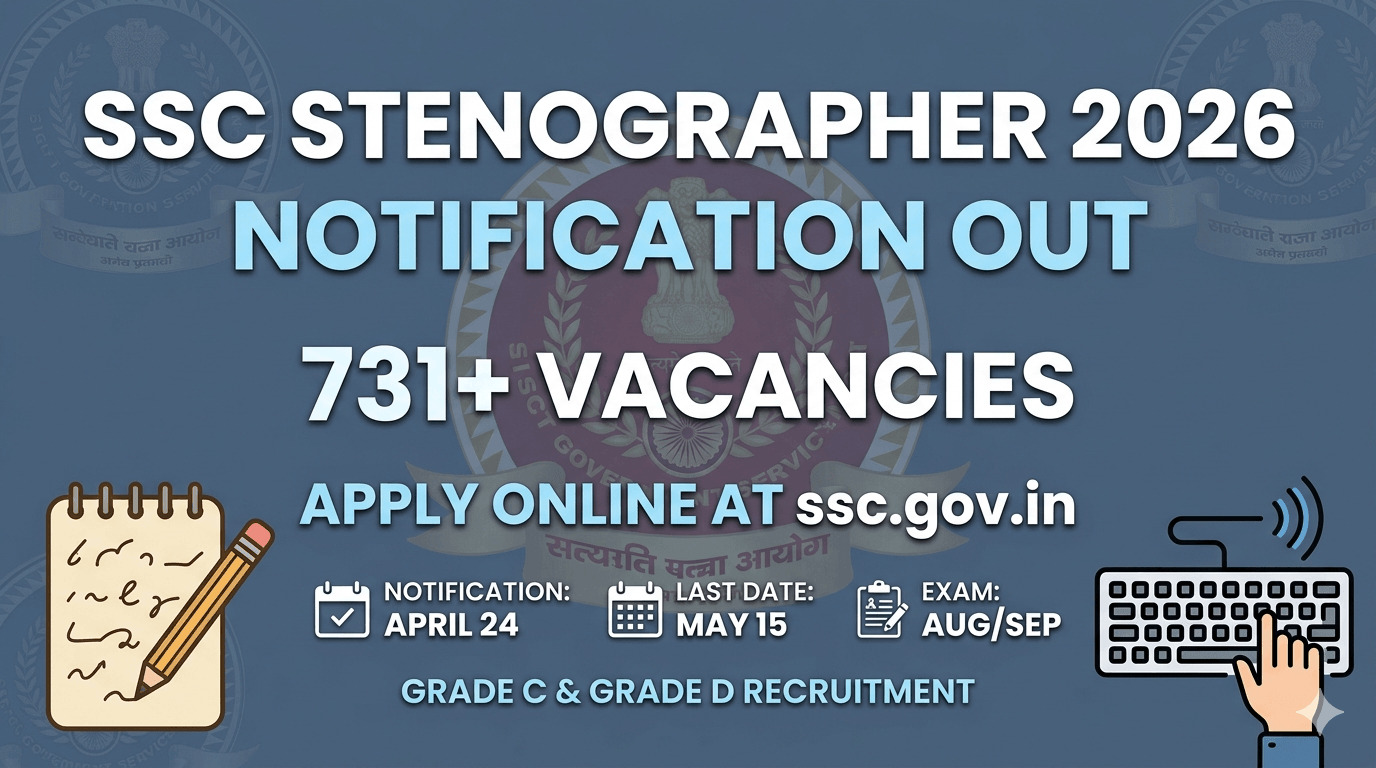
The Staff Selection Commission (SSC) has officially released the much-awaited SSC Stenographer 2026 notification on April 24, 2026. This recruitment drive aims to fill approximately 731 vacancies for Stenographer Grade C and Grade D posts across various Central Government Ministries, Departments, and Organizations. If you have been waiting for a stable government job with a focus on stenography skills, the window to apply is now open.

Aspiring candidates can submit their applications through the official SSC website at ssc.gov.in. It is important to note that the application process is strictly online. This year, the Commission has emphasized early registration to avoid the typical last-minute server congestion.


Important Dates for SSC Stenographer 2026 Recruitment

Staying updated with the recruitment timeline is crucial for every serious aspirant. Based on the official notification, here are the key dates you must remember:

Notification Release Date: April 24, 2026

Start Date for Online Application: April 24, 2026

​Last Date for Online Application: May 15, 2026 (by 23:00 hours)

​Last Date for Online Fee Payment: May 16, 2026

​Application Correction Window: May 20 to May 21, 2026

​SSC Stenographer CBT Exam Date: Scheduled for August or September 2026


Important Links for SSC Stenographer 2026:

Official Website: https://ssc.gov.in

Download Full Notification (PDF): Click Here to View/Download

Direct Link to Apply Online: Apply Now at ssc.gov.in


SSC Stenographer Vacancy 2026 Details

​While the notification currently mentions approximately 731 tentative vacancies, this number is subject to change. Historically, the SSC often increases the vacancy count as the recruitment process progresses and various departments report their final requirements. The vacancies are divided into two main categories:

​Stenographer Grade C: Generally higher-level posts with a higher pay scale, often located in Delhi-based ministries.

​Stenographer Grade D: Group C posts available in various offices across India.

​Candidates should check the official PDF for category-wise distribution (SC, ST, OBC, EWS, and UR) once the detailed vacancy chart is uploaded on the ‘Candidate’s Corner’ of the SSC website.


Eligibility Criteria for SSC Stenographer 2026

Before you proceed to fill out the form, ensure you meet the following eligibility requirements as of the cutoff date mentioned in the notification.

Educational Qualification:

Candidates must have passed the 12th standard (Intermediate) or an equivalent examination from a recognized Board or University. This is a great opportunity for higher secondary pass students to enter the central government services.

Age Limit (as of August 1, 2026):

Stenographer Grade C: 18 to 30 years.

Stenographer Grade D: 18 to 27 years.

Age relaxation is applicable for reserved categories such as SC/ST (5 years), OBC (3 years), and PwBD as per the existing Government of India rules.


SSC Stenographer 2026 Selection Process

​The selection process is divided into two major stages. Unlike many other SSC exams, there is no Tier 2 written exam; instead, the skill test is the deciding factor.

1. Computer Based Examination (CBT):

The online exam consists of objective-type multiple-choice questions. The subjects included are:

  • ​General Intelligence and Reasoning (50 Questions)
  • ​General Awareness (50 Questions)
  • English Language and Comprehension (100 Questions)
  • Total Marks: 200. Duration: 2 Hours.

Please note that there is a negative marking of 0.25 marks for each wrong answer.


2. Skill Test in Stenography:

Candidates who clear the CBT cutoff will be called for the Skill Test. This test is qualifying in nature.

  • For Grade C: Dictation at 100 words per minute (wpm).
  • For Grade D: Dictation at 80 words per minute (wpm).

Candidates will have to transcribe the dictation on a computer within the specified time limit.


How to Apply Online at ssc.gov.in

​Follow these steps to complete your application smoothly:

  1. ​Visit the official website: ssc.gov.in
  2. ​If you are a new user, complete the ‘One Time Registration’ (OTR). If you already have an OTR for the new portal, simply log in.
  3. Navigate to the ‘Apply’ tab and select ‘Stenographer Grade C & D Examination 2026’.
  4. Fill in the required details, including your educational background and preferred exam centers.
  5. ​Upload your recent photograph and signature according to the specified dimensions.
  6. Pay the application fee of Rs. 100 (Women, SC, ST, PwBD, and ESM candidates are exempted from payment).
  7. ​Review your application and submit. Take a printout for future reference.


Preparation Strategy for the 2026 Exam

​With the exam scheduled for August/September, you have approximately four months to prepare. Focus heavily on the English Language section as it carries 50% of the total weightage. Improving your reading comprehension and grammar will give you a significant edge. Simultaneously, dedicate at least one hour daily to shorthand practice to ensure you are ready for the skill test immediately after the results.

​For more updates on government job notifications and study material, keep visiting our blog and subscribe to our newsletter.


SSC Stenographer Salary 2026: 7th Pay Commission Benefits

One of the biggest motivations for this exam is the attractive salary and perks provided by the Central Government. The pay structure is determined by the 7th Pay Commission and depends on the city of posting (X, Y, or Z category cities).

Stenographer Grade C Salary:

Grade C posts are generally Group B (Non-Gazetted) positions. The pay scale ranges from Rs. 9,300 to Rs. 34,800 with a Grade Pay of Rs. 4,200 or Rs. 4,600.

​In-hand Salary: Approximately Rs. 51,000 to Rs. 60,000 per month.

Stenographer Grade D Salary:

Grade D posts are Group C positions. The pay scale is Rs. 5,200 to Rs. 20,200 with a Grade Pay of Rs. 2,400.

​In-hand Salary: Approximately Rs. 36,000 to Rs. 43,000 per month.


SSC GD 2026: How to Prepare in Short Time? Final 10-Day Revision Strategy

Student studying for SSC GD 2026 with a 10-day master revision plan and mock test on laptop

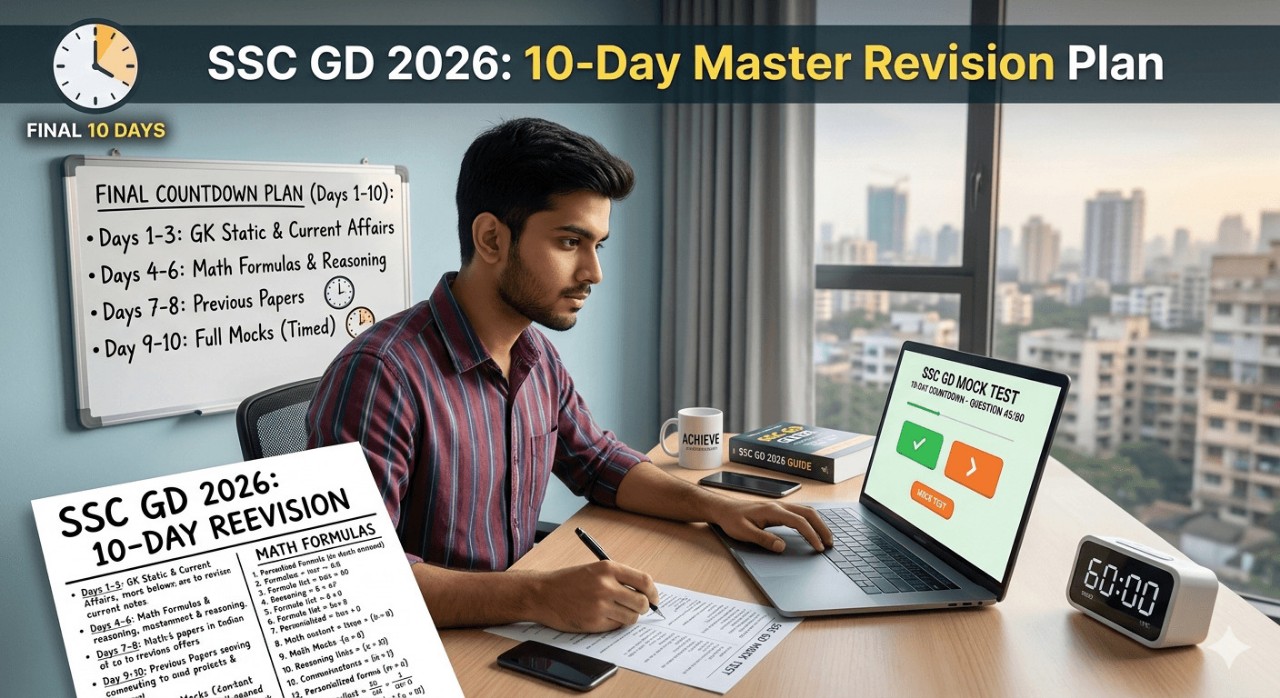
The Staff Selection Commission has officially released the SSC GD City Intimation. Now that you know your exam date and city, the countdown has truly begun. For many aspirants, this is the moment of realization: “Is there enough time to finish the syllabus?”

​The answer is Yes. But you cannot study like you did three months ago. You need a “Smart Revision” approach rather than a “Full Study” approach. In this guide, we will break down exactly what to focus on to maximize your score in these final days.


1. Understand the Reality: Quality Over Quantity

​With the exam just days away, do not try to pick up brand-new, difficult chapters. If you haven’t mastered Trigonometry or Advanced Algebra yet, leave them. SSC GD is a matriculation-level exam where speed and accuracy in basic topics carry more weight than complex problem-solving.

The 80/20 Rule for SSC GD

​Focus on the 20% of the syllabus that generates 80% of the marks. In the SSC GD 2026 pattern, you have 80 questions to solve in just 60 minutes. This means you have less than 45 seconds per question.


2. Subject-Wise “Must-Revise” Topics

​If you are short on time, ensure these specific topics are on your fingertips:

​Elementary Mathematics (20 Questions)

​Math is the section where you can score a perfect 40/40 if your basics are clear.

​Profit, Loss, and Discount: Expect 3-4 questions. Memorize the relationship between CP, SP, and MP.

​Percentage & Ratio: These are the “base” of math. Most questions can be solved using ratio methods.

​Time, Speed, and Distance: Focus on “Average Speed” and “Relative Speed” (train problems).

​Mensuration: Simply memorize the formulas for Area and Volume (Cylinder, Cone, Sphere). SSC rarely asks deep conceptual questions here; they are usually formula-based.


​General Intelligence & Reasoning (20 Questions)

​This is the highest-scoring section. Don’t spend hours here; just practice.

​Coding-Decoding: Practice 50 questions to recognize patterns quickly.

​Number Series: Focus on square/cube patterns and “gap-of-gap” logic.

​Syllogism: Use Venn diagrams to avoid confusion.

​Seating Arrangement: Practice 1-2 linear and circular arrangements daily to reduce your solving time.


​General Knowledge & Awareness (20 Questions)

​The syllabus is vast, so stay focused:

​Static GK: Focus on Indian Folk Dances, Festivals, National Parks, and Census 2011.

​Current Affairs: Revise the last 6-8 months. Focus on Sports (IPL/World Cup), Awards, and New Appointments.

​Polity: Articles related to Fundamental Rights and the President are favorites of SSC.


Important Note: Before starting your revision, make sure you have checked your exam date and center location. If you haven’t seen it yet, read our guide on how to download the SSC GD City Intimation Slip 2026 here.

Visit the Official Website: Go to ssc.gov.in.

3. The 10-Day “Power Revision” Schedule

​Use this table to organize your final days. Stick to this strictly to avoid burnout.

Days 1 to 3: The Weak Link Phase

Identify the topics where you feel 50% confident. Do not touch things you know nothing about. Instead, watch “one-shot” revision videos for these middle-ground topics and solve 20 practice questions for each.

​Days 4 to 6: Formula and Logic Mastery

Spend these three days cementing your speed. Revise every Math formula and Reasoning shortcut. You should also start solving one full-length mock test daily during the exact time slot of your actual exam.

Days 7 to 8: General Awareness Marathon

Read 6-month compilation PDFs. Focus on “Who’s Who” and major sports updates from late 2025 and early 2026. This is purely a memory game, so repeat the facts aloud.

Day 9: Previous Year Focus

Solve at least three or four actual papers from the 2024 or 2025 recruitment cycles. This helps you understand the “language” of the questions SSC likes to ask.

Day 10: Mental Preparation

Stop heavy studying by noon. Review your personal formula sheet, double-check your exam center location from the city intimation, and rest your mind.


4. The “Mock Test” Secret

​Many students make the mistake of solving mocks but not analyzing them. After the City Intimation is out, your mock test strategy should change:

​Timed Practice: Always solve mocks in 60 minutes. No pauses.

​Order of Attempt: Try starting with GK (5 mins) \rightarrow Hindi/English (7 mins) \rightarrow Reasoning (18 mins) \rightarrow Math (25-30 mins). This ensures you see every question in the paper.

​The “Skip” Art: If a Math question takes more than 1 minute, SKIP IT. Mark it for review and move on. Every question carries equal marks; don’t die on one difficult question.


5. Avoiding Negative Marking

​Since there is a 0.25 negative marking, accuracy is your best friend.

​If you are 100% sure, mark it.

​If you can eliminate two options, take a calculated risk.

​If you have no idea, leave it. Scoring 0 is better than scoring -0.25.


6. Essential Document Checklist for Exam Day

​Now that you have seen your City Intimation, you will soon be able to download the full Admit Card (usually 4 days before your exam date). Prepare a small folder now with the following items to avoid last-minute panic:

​Printout of the Admit Card: Preferably a clear color printout.

​Original Photo ID Proof: This must have the same Date of Birth as mentioned on your application (Aadhaar Card, Voter ID, or Driving License).

​Recent Passport Size Photographs: Carry at least two copies, identical to the one uploaded in the form.

​Transparent Water Bottle: Most centers only allow clear bottles without any labels.


Conclusion

​The SSC GD 2026 exam is a test of your speed and mental toughness. Since the City Intimation is already in your hands, stop worrying about what you haven’t studied and start perfecting what you have. Consistency in these final 10 days can be the difference between a “Qualified” and “Not Qualified” status.

​Stay focused, keep your admit card details ready, and give it your best shot!


🚨 SSC Selection Post 2026 Notification OUT – Apply Now | Eligibility, Vacancy, Salary, Last Date (Full Details)

SSC Selection Post Phase XIV 2026 All India Notification 3003 Vacancies Job Alert
🔥 Big Opportunity for Government Job Aspirants!
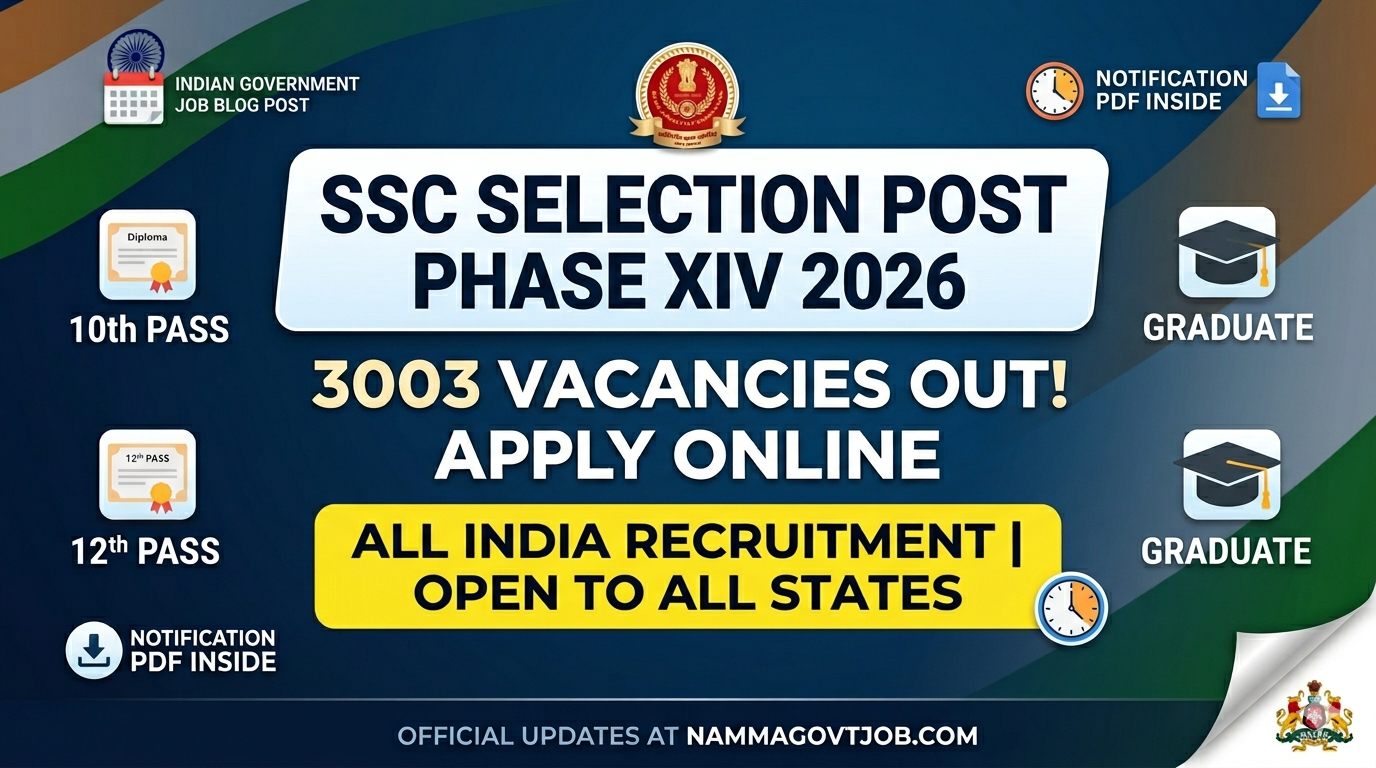
The Staff Selection Commission has released the SSC Selection Post Phase 14 Notification 2026, opening doors for thousands of candidates across India.
👉 Whether you are 10th pass, 12th pass, or a graduate, this recruitment offers a wide range of opportunities in different departments.
💡 If you’re serious about getting a government job, don’t skip this chance!


Why This Notification is Different (And Better!)

​Most big websites just copy-paste the notification. But at Namma Govt Job, we analyze the “why.” The Selection Post is unique because:

​Lower Competition: Because people find the “Post Code” system confusing, fewer people apply for specific technical posts.

Single Exam: You only need to clear one computer-based test to move to the scrutiny stage.

​Variety: From Laboratory Attendants in Karnataka to Clerks in Delhi, the options are massive.


📅 Important Dates Selection Post Phase XIV You Must Remember!

Notification Release: April 13, 2026

Online Application Start: April 13, 2026

Last Date to Apply: May 04, 2026 (Until 11:00 PM)

​Last Date for Online Fee Payment: May 05, 2026

Admit Card Release: June 2026

Exam Date: June–July 2026


📊 Total Vacancies Selection Post Phase XIV

The 3003 vacancies are spread across different categories. This year, the distribution is quite balanced, giving a fair chance to everyone:

👉 Vacancies are distributed across multiple ministries, departments, and regions.

Unreserved (UR): 1534 Posts

​OBC: 667 Posts

​SC: 346 Posts

​ST: 185 Posts

​EWS: 271 Posts

​These vacancies are divided into three levels: Matriculation (10th), Higher Secondary (12th), and Graduation & Above.


🎯 Eligibility Criteria: Can You Apply?

One of the most common questions we get is about eligibility. The age and education are calculated as of January 01, 2026.

🧑‍🎓 Educational Qualification

For 10th Level Posts: You must have passed Class 10 from a recognized board.

​For 12th Level Posts: You must have passed Class 12 (10+2) or equivalent.

​For Graduate Level Posts: A Bachelor’s degree in any stream. Some specialized posts might ask for specific subjects like Biology, Chemistry, or Library Science.

👉 Each post has specific requirements, so read carefully before applying.


🎂 Age Limit

Minimum Age: 18 years

Maximum Age: 30 years (varies by post)

👉 Age relaxation:

OBC: +3 years

SC/ST: +5 years

PwD: As per rules


💼 Types of Posts Available

Some common posts include:

Clerk

Data Entry Operator (DEO)

Laboratory Assistant

Junior Engineer

Technical Staff

Multi-Tasking Staff (MTS)

👉 Posts vary based on qualification and department.


The “Post Code” Strategy: Don’t Make This Mistake!

​This is where 50% of students fail. You don’t just apply for “Phase 14.” You apply for a Post Code (Example: KK10226).

​How to Choose a Post:

  • ​Go to the official SSC website and look for the “Post Details” link.
  • Filter by your region (e.g., KKR for Karnataka-Kerala Region).
  • Look for “Essential Qualification” (EQ). If a post asks for “1-year experience in a Lab,” and you don’t have it, do not apply. You will be rejected during scrutiny even if you top the exam.
  • Search for posts that only ask for “10th Pass” or “12th Pass” with no extra experience. These have more competition but are safer if you are a fresh candidate.


💰 Salary Structure

Salary Range: ₹18,000 to ₹81,000 per month

Pay Level: Level 1 to Level 7

Additional Benefits:

✔ Dearness Allowance (DA)

✔ House Rent Allowance (HRA)

✔ Medical Benefits

✔ Pension & Job Security

👉 Government jobs offer long-term stability and growth.


📝 Selection Process

The recruitment process includes:

1️⃣ Computer-Based Test (CBT)

Objective-type exam

Conducted online

2️⃣ Skill Test (if required)

Typing / Data Entry / Practical (post-specific)

3️⃣ Document Verification

Final stage before selection


📚 Exam Pattern (CBT)

Total Questions: 100

Total Marks: 200

Duration: 60 minutes

Subject Wise Distribution:

  • ​General Intelligence (Reasoning): 25 Questions (50 Marks)
  • General Awareness (GK/Current Affairs): 25 Questions (50 Marks)
  • Quantitative Aptitude (Maths): 25 Questions (50 Marks)
  • ​English Language: 25 Questions (50 Marks)

​Important Note on Negative Marking:

Each correct answer gives you 2 marks. However, there is a heavy negative marking of 0.50 marks for every wrong answer. Accuracy is more important than speed here!


💸 Application Fee

General/OBC: ₹100

SC/ST/PwD/Female Candidates: No Fee


📲 Step-by-Step: How to Apply Online

  1. Visit the official SSC website
  2. Complete registration (if new user)
  3. Log in with credentials
  4. Fill application form carefully
  5. Upload photo & signature
  6. Pay application fee
  7. Submit form and download confirmation

👉 Always keep a copy for future reference.


Important Links for SSC Phase 14 Recruitment 2026

​Download Official Notification PDF: [“Click Here to Download SSC Phase 14 Notification“]

Direct Link to Apply Online: [Apply Here @ssc.gov.in]

​Check Post Codes & Requirements: [View Post Details]

​Official SSC Website: [ssc.gov.in]


🔥 Why SSC Selection Post is Important?

✔ Huge number of vacancies

✔ Suitable for all education levels

✔ Less competition compared to CGL

✔ Easier exam pattern

✔ Government job benefits

👉 Many candidates ignore this exam — which gives you an advantage!


📈 Preparation Tips (Must Read)

If you want to crack this exam:

✔ Focus on Basics

NCERT-level math & reasoning

Daily current affairs

✔ Practice Mock Tests

Improve speed & accuracy

✔ Time Management

Don’t spend too much time on one question

✔ Previous Year Papers

Understand exam pattern deeply

👉 Consistency is the key to success.


Common Mistakes to Avoid

Applying without checking eligibility

Waiting till last date

Ignoring syllabus

Not practicing mock tests

👉 Avoid these and you’ll already be ahead of many candidates.


Frequently Asked Questions (FAQs)

Q1. Who can apply for SSC Selection Post?

👉 Candidates who are 10th pass, 12th pass, or graduates can apply.

Q2. Is there an interview?

👉 No, selection is based on CBT + skill test (if required).

Q3. Is this exam tough?

👉 It is easier compared to SSC CGL, but competition still exists.

Q4. Can final-year students apply?

👉 Only if they meet eligibility before the deadline.

Q5. Is this a permanent job?

👉 Yes, most posts are permanent government jobs.


🚀 Pro Tip for Serious Aspirants

If you are preparing for exams like SSC CGL, this exam works as:

👉 Practice + Real exam experience

👉 Confidence booster

👉 Backup opportunity


📢 Final Words

The Staff Selection Commission Selection Post Phase 14 is a golden opportunity for lakhs of aspirants.

📌 Apply early

📌 Start preparation today

📌 Don’t miss this chance

👉 Share this article with your friends so they don’t miss this opportunity!


Indian Bank SO Recruitment 2026 Notification Out: Apply for 350 Specialist Officer Posts

Official notification for Indian Bank Specialist Officer SO Recruitment 2026 showing 350 vacancies.

​Great news for banking aspirants! Indian Bank has officially released a massive recruitment notification today, April 8, 2026, for the position of Specialist Officers (SO). If you have been waiting for a stable, high-paying government job in the banking sector, this is a golden opportunity to join one of India’s leading Public Sector Banks.

​This recruitment drive aims to fill 350 vacancies across various scales and specializations, including Assistant Manager (Scale I), Manager (Scale II), and Senior Manager (Scale III).

​In this comprehensive guide, we will cover everything you need to know about the Indian Bank SO Recruitment 2026, including eligibility criteria, important dates, application fees, and the selection process.


Indian Bank SO Recruitment 2026: Important Dates

​Staying updated with the timeline is crucial to ensure you don’t miss the deadline. The registration window is short, so mark your calendars:

Notification Release Date:   April 8, 2026

Online Registration Starts:   April 8, 2026

Last Date to Apply Online:   April 28, 2026

Last Date for Fee Payment:  April 28, 2026

Online Exam Date:                  To be Announced (TBA)

Interview Schedule:                To be Announced (TBA)


Vacancy Details by Post

​The 350 vacancies are distributed across several technical and professional departments. Some of the key roles include:

Information Technology (IT)

​Finance & Credit

​Risk Management

​Marketing

​Human Resource Management

​Civil Engineering & Architecture

​These posts are divided into Scale I (Assistant Manager), Scale II (Manager), and Scale III (Senior Manager) based on the required experience and expertise.


Eligibility Criteria

​Before applying, candidates must ensure they meet the specific requirements set by Indian Bank.

1. Educational Qualification

​The required qualification varies depending on the specific post code. Generally, the following degrees are accepted:

IT/Software: B.E./B.Tech in Computer Science/IT or MCA.

Finance/Credit: MBA (Finance), CA, ICWA, or CFA.

Generalist Roles: Post-graduation in relevant fields like HR, Marketing, or Statistics.

Engineering: Degree in Civil Engineering or Architecture for specific technical posts.

2. Age Limit (as of April 1, 2026)

​The age limit depends on the Scale of the post:

Scale I: 22 to 30/32 years.

Scale II: 25 to 35 years.

Scale III: 27 to 38 years.

​(Note: Age relaxation is applicable for reserved categories—5 years for SC/ST, 3 years for OBC, and 10 years for PwBD candidates.)


Indian Bank SO Exam Pattern & Syllabus

​If the bank receives a high volume of applications, an online test will be conducted. Here is the expected pattern:

SubjectQuestionsMarksDuration
Professional Knowledge 60 120 2 Hours (Composite)
Reasoning Ability 40 40
English Language 20 20
Quantitative Aptitude 40 40
Total 160 220 120 Minutes


Selection Process

​Indian Bank follows a structured selection process to ensure the best talent is recruited. Depending on the number of applications received, the bank may choose one of the following methods:

Shortlisting & Interview: Based on the candidate’s profile, followed by a personal interview.

Written/Online Test & Interview: * The written test typically consists of 120 questions carrying 180 marks.

The duration is 2 hours.

​Negative Marking: There is a penalty of 1/4th mark for every wrong answer.

Qualifying Marks: 40% for General/EWS and 35% for SC/ST/OBC/PwBD.


Application Fee

​Candidates must pay the application fee online through Debit/Credit cards, Internet Banking, or UPI.

SC / ST / PwBD: ₹175/- (Intimation charges only).

All Others (General/OBC/EWS): ₹1,000/- (Including GST).


How to Apply Online for Indian Bank SO 2026

​Follow these steps to complete your application smoothly:

Visit the Official Website: Go to indianbank.bank.in.

Navigate to Careers: Click on the “Careers” tab on the homepage.

Find the Notification: Click on “Recruitment of Specialist Officers – 2026.”

Register: Click on “Click here for New Registration” and provide your basic details (Name, Email, Mobile Number).

Fill Application: Log in with your registration ID and password to fill out the detailed form.

Upload Documents: Upload your photograph, signature, and relevant certificates as per the prescribed format.

Payment: Pay the application fee and submit the form.

Print: Save a copy of the application form and fee receipt for future reference.


Why Choose a Career in Indian Bank?

​Joining Indian Bank as a Specialist Officer is not just about a job; it’s about a career with long-term growth.

Attractive Salary: Scale I officers start with a competitive pay scale, including DA, HRA, and other allowances.

Job Security: Being a Public Sector Bank (PSB), it offers immense job stability.

Work-Life Balance: Compared to the private sector, PSBs offer better leave policies and structured working hours.

Growth Opportunities: With internal exams and promotions, you can rise to senior management positions quickly.


Expert Preparation Tips

​To crack the Indian Bank SO exam, focus on your Professional Knowledge. Since these are specialized roles, a significant portion of the test will focus on your core subject (IT, Finance, etc.). Additionally, keep your English Language and Reasoning skills sharp, as these are often part of the online screening.

​Make sure to download the official PDF from the website and read the specific requirements for your post code carefully before applying.


Conclusion

​The Indian Bank SO Recruitment 2026 is a prestigious opportunity for professionals to enter the banking sector at a management level. With a high salary and excellent growth prospects, this is one notification you cannot afford to ignore. Start your preparation today by focusing on your professional domain!


Important Links

​Official Website: indianbank.bank.in

Apply Online Link: Click Here to Register


12th Pass? Get a Central Govt Job! SSC CHSL 2026 Complete Guide, Salary & Expected Notification Dates

SSC CHSL 2026 Notification and Exam Guide for 12th Pass Students

​If you have just finished your 12th standard or looking for a stable career in the Central Government, you have likely heard the term “SSC CHSL.” But what exactly is it, and why is everyone waiting for it?

​Most big websites just give you a table of dates and leave you confused. At Namma Govt Job, we believe in making things simple. This guide will walk you through everything—from the upcoming 2026 dates to the “in-hand” salary and a secret strategy to clear the exam on your first attempt.


The Secret Shortcut to a Central Govt Job After 12th: SSC CHSL 2026 Mega Guide

Are you tired of hearing that you need a Master’s degree or 10 years of experience to get a high-paying job? If you have passed your 12th standard (10+2), you are already eligible for one of India’s most prestigious government exams.

​We are talking about the SSC CHSL 2026.

​While big coaching websites are busy selling expensive courses, here at Namma Govt Job, we want to give you the raw truth. You don’t need a miracle to pass; you just need the right information at the right time. In this massive guide, we break down why this exam is the “Golden Ticket” for every 18-year-old in India.


📅 Important Dates to Save on Your Phone

​Don’t miss these deadlines, or you’ll have to wait another year!

​Official Notification Date: April 30, 2026

Online Application Starts: April 30, 2026

Last Date to Apply: May 31, 2026

​Tier 1 Exam (CBT): July – August 2026

​Tier 2 Exam: To be announced (Usually 3 months after Tier 1)

Why wait for April? If you start today, you have nearly four months to master the syllabus. While others are searching for the “Apply Link” in May, you will already be finishing your revision.

📊 SSC CHSL 2026 Exam Pattern (Detailed Breakdown)

To win a race, you must know the track. The SSC CHSL has two main stages (Tiers).

Stage 1: Tier-1 (The Qualifying Round)

​This is a Computer Based Examination (CBT) with 100 questions. You have 60 minutes to finish.

English Language: 25 Questions (50 Marks)

General Intelligence (Reasoning): 25 Questions (50 Marks)

Quantitative Aptitude (Maths): 25 Questions (50 Marks)

General Awareness (GK): 25 Questions (50 Marks)

Negative Marking in Tier 1: 0.50 marks will be deducted for every wrong answer.Accuracy is your best friend!

Stage 2: Tier-2 (The Merit Maker)

​Your final selection is based ONLY on Tier-2 marks. It is conducted in two sessions on the same day.

Section 1: Maths (30 Qs) & Reasoning (30 Qs) — 180 Marks (1 Hour)

Section 2: English (40 Qs) & General Awareness (20 Qs) — 180 Marks (1 Hour)

Section 3: Computer Knowledge (15 Qs) — 45 Marks (15 Minutes)

Section 4: Skill Test / Typing Test (Qualifying)

​Important Note on Negative Marking: Be very careful in Tier 2! Unlike Tier 1, there is a negative marking of 1 full mark for every wrong answer in Tier 2. Since each correct answer gives you 3 marks, one mistake can cost you dearly. Don’t guess if you aren’t sure!


💰 Salary Check: Can a 12th Pass Student Earn ₹40,000?

​Yes, they can. The SSC CHSL offers different pay levels based on the post. Here is the breakdown of what will actually enter your bank account every month:

1. Lower Division Clerk (LDC) / JSA

Pay Level: 2

In-Hand Salary: ₹29,000 to ₹33,000 (depending on your city).

2. Data Entry Operator (DEO)

Pay Level: 4 or 5

In-Hand Salary: ₹38,000 to ₹48,000.

​Imagine earning nearly ₹50,000 a month just by using your 12th-grade certificate. This is why the competition is high, and why you need to be serious.


✅ Eligibility: Do You Qualify?

​The requirements are simple, but there are a few “hidden” rules you must know.

1. Education: You must have passed 12th Standard(10+2)  from a recognized board.

Note: If you want to be a DEO in the C&AG office, you must have 12th Science with Mathematics. For all other posts, any stream (Arts, Commerce, Science) is fine!

​2. Age: 18 to 27 years.

​If you are 18 today, you are at the perfect age to start.

Relaxations: OBC candidates get 3 extra years, and SC/ST candidates get 5 extra years.


📖 The “Simple” Syllabus (Don’t Be Scared!)Tier-1

​The exam is not “hard”; it is just “fast.” You have to solve 100 questions in 60 minutes.

English (25 Qs): Fill in the blanks, error spotting, and simple grammar.

Reasoning (25 Qs): Logical puzzles, blood relations, and mirror images.

Maths (25 Qs): Profit & loss, percentage, and basic algebra (10th level math).

General Awareness (25 Qs): Current affairs, Indian History, and Geography.


​Most big sites tell you to buy 500-page books.

We say: Master the 10th-grade NCERT books first. If your basics are strong, no one can stop you.


Since Namma Govt Job is your personal guide, here is a strategy that “Big Portals” won’t tell you:

Step 1: The Typing Secret

​Many students pass the written exam with 180/200 marks but fail the typing test. They start practicing typing after the result. That is a mistake! Start typing for 10 minutes every day from today. You need a speed of 35 words per minute.

Step 2: Focus on Current Affairs (The Smart Way)

​Don’t waste 2 hours every day watching YouTube news. Just read a monthly PDF summary. SSC asks questions from the last 6–8 months of news. Focus on Sports (Cricket!), Awards, and New Govt Schemes.

Step 3: Mock Tests are Life

​Doing 100 mock tests is better than reading 100 books. On our blog, we will soon be uploading Free Daily Quizzes to help you practice on your mobile phone!


🖥️ Why Choose SSC CHSL over Other Jobs?

​Work-Life Balance: Most offices are 9 to 5. You get weekends off!

​Promotions: You can give internal exams and become an Officer (Group B) within a few years.

​Respect: Working for the Central Government of India brings immense pride to your family.


Final Verdict: Should You Apply?

​If you are a 12th-pass student in 2026, the SSC CHSL 2026 is not just an option—it is a necessity. It is the safest way to secure your future in an uncertain job market.

​What should you do now?

​Start practicing basic Math and English for 1 hour a day.

​Bookmark nammagovtjob.com. We will be the first to give you the “Direct Apply Link” on April 30!

​Have a question about your age or education? Drop a comment below! I reply to every single comment personally.

UPSSSC Lower PCS Recruitment 2026: 2,285 Vacancies Full Notification, Eligibility, Exam Pattern, and Salary

UPSSSC Lower PCS 2026 Recruitment Notification for 2,285 vacancies, featuring three Indian aspirants and the UP Vidhan Sabha.

The Uttar Pradesh Subordinate Services Selection Commission (UPSSSC) has finally ended the long wait for thousands of aspirants by releasing the official notification for the Combined Lower Subordinate Services Examination 2026. This is one of the most prestigious state-level recruitments in Uttar Pradesh, offering high-ranking administrative positions in various government departments.

​With a total of 2,285 vacancies, this year presents a massive opportunity for graduates who have appeared in the UPSSSC PET 2025. In this comprehensive guide, we will break down everything you need to know: from the detailed post-wise vacancy to the specific educational requirements and the expected exam syllabus.

1. UPSSSC Lower PCS 2026: Important Dates & Timeline

​Timing is everything when it comes to government job applications. Mark your calendars with these official dates provided by the commission:

Official Notification Release: March 30, 2026

Start Date for Online Application: May 29, 2026

Last Date to Apply & Pay Fee: June 18, 2026

Last Date for Form Correction/Adjustment: June 25, 2026

​Important Note: The application window is relatively short (less than a month), so we highly recommend completing your registration in the first week of June to avoid any technical glitches on the official portal.


2. Detailed Vacancy Breakdown (Total 2,285 Posts)

​The recruitment covers several departments. While the full department-wise list is extensive, here are the primary roles available:

Post NameTotal VacanciesPay Level (7th CPC)
Executive Officer (Panchayati Raj) 840 Level-6 (₹35,400 - ₹1,12,400)
Assistant Revenue Officer 512 Level-6 (₹35,400 - ₹1,12,400)
Assistant Treasury Accountant 430 Level-5 (₹29,200 - ₹92,300)
Supply Inspector 215 Level-6 (₹35,400 - ₹1,12,400)
Marketing Inspector 188 Level-6 (₹35,400 - ₹1,12,400)
Clerk-cum-Typist / Junior Assistant 100 Level-4 (₹25,500 - ₹81,100)


3. Eligibility Criteria: Who Can Apply?

​To be eligible for the UPSSSC Lower PCS 2026, candidates must satisfy three main criteria:

A. Mandatory Exam (PET 2025)

​This is the most critical requirement. Only candidates who appeared in the Preliminary Eligibility Test (PET) 2025 and have a valid scorecard (non-zero or non-negative marks) are eligible to apply. The commission will shortlist candidates for the Main Exam based on their PET scores.

B. Educational Qualifications

General Requirement: A Bachelor’s Degree in any discipline from a recognized University in India.

Specialized Requirements: Certain posts like Assistant Treasury Accountant may require a degree in Commerce (B.Com) or a Post Graduate Diploma in Accountancy.

Computer Proficiency: Posts like Executive Officer and Clerk often require a “CCC” certificate from NIELIT or an “O” Level certificate.

C. Age Limit (As of July 1, 2026)

Minimum Age: 21 Years

Maximum Age: 40 Years

Age Relaxation: SC/ST/OBC candidates of Uttar Pradesh will receive a 5-year relaxation. PwD candidates receive up to 15 years of relaxation.


4. Selection Process: The Road to Success

​The selection for UPSSSC Lower PCS involves a two-stage filtering process:

Shortlisting: Based on the PET 2025 Scorecard. Usually, candidates equal to 15 times the number of vacancies are called for the Main Exam.

Main Written Examination: This is the deciding factor. It usually consists of two papers or one comprehensive paper covering General Intelligence, General Knowledge, General Science/Arithmetic, and General Hindi.

Document Verification: Final merit list holders will be called for original document verification.

5. Expected Exam Pattern for Lower PCS Mains

​While the specific syllabus for 2026 will be released later, based on previous years, here is what you should start preparing for:

General Intelligence (Reasoning): 25 Questions (50 Marks)

General Knowledge (GK): 50 Questions (100 Marks)

General Science & Arithmetic: 50 Questions (100 Marks)

General Hindi: 25 Questions (50 Marks)

Total: 150 Questions | 300 Marks | 2 Hours Duration.

6. Salary and Career Growth

​Joining the Lower PCS cadre offers not just a high salary but also significant social status and job security. A Level-6 officer starts with a basic pay of ₹35,400. Including HRA (House Rent Allowance) and DA (Dearness Allowance), the gross monthly salary in a city like Lucknow or Kanpur can be around ₹55,000 to ₹62,000.

7. Step-by-Step Guide: How to Apply Online

​Follow these steps to ensure your application is submitted correctly:

​Go to the official UPSSSC portal: upsssc.gov.in.

​Navigate to the ‘Applicant Segment’ and click on ‘Candidate Registration’.

​Choose the option to login via PET Registration Number. Enter your details and verify with the OTP sent to your registered mobile/email.

​Once logged in, your basic details from PET will be auto-filled. Complete the remaining sections regarding your educational qualifications.

​Upload your latest photograph and signature (if required, though often these are pulled from PET records).

​Pay the Application Fee of ₹25 via SBI Collect or Credit/Debit card.

​Download the Application Form Receipt. Do not skip this step.


Conclusion

​The UPSSSC Lower PCS 2026 is a golden opportunity for those looking to serve in the Uttar Pradesh state administration. With 2,285 seats, the competition will be tough, but early preparation is the key. Focus on your General Hindi and UP-specific General Knowledge to gain an edge over other candidates.

​For more updates on UPSSSC Result dates, Cut-off marks, and Study Material, stay tuned to our blog!


Frequently Asked Questions (FAQs)

Q1: Can candidates from other states apply for UPSSSC Lower PCS?

Yes, candidates from other states can apply, but they will be treated as General category candidates, even if they belong to a reserved category in their home state. Also, having a valid UPSSSC PET 2025 score is mandatory.

Q2: Is there a negative marking in the Lower PCS Main exam?

Yes, usually there is a negative marking of 1/4th (0.25 marks) for every wrong answer. It is important to avoid blind guessing.

Q3: What is the PET 2025 Cut-off for Lower PCS?

While the official cut-off is released after applications are received, experts suggest that candidates with a 90+ percentile in PET 2025 have a very high chance of being shortlisted for these 2,285 posts.

Q4: Can I edit my application after submission?

You can make corrections to certain fields like your name spelling, category, or educational details until the modification deadline, which is June 25, 2026.