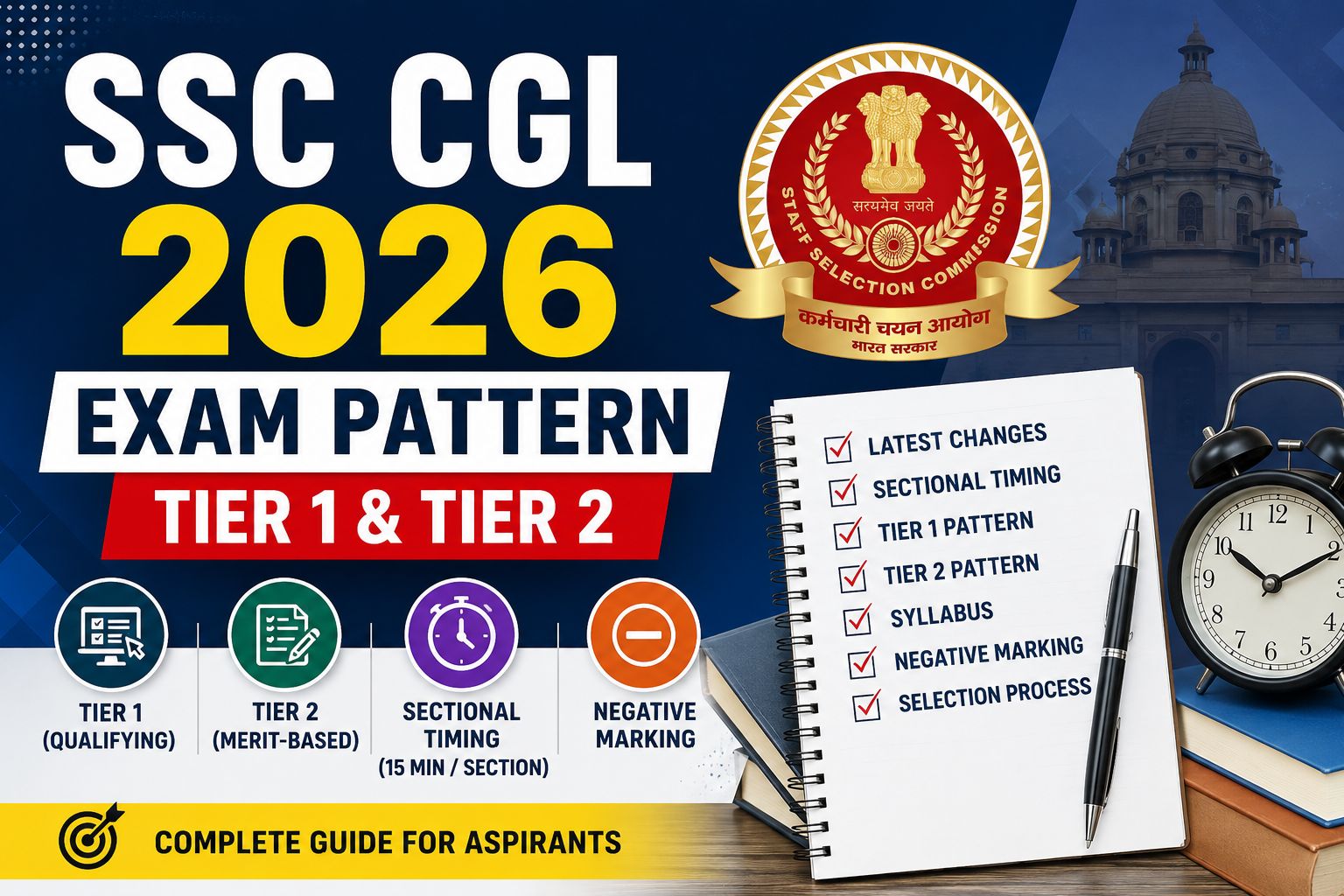
SSC CGL 2026 New Exam Pattern: Complete Guide for Tier 1 & Tier 2 (Latest Changes Explaine

SSC CGL 2026 Exam Pattern Tier 1 and Tier 2 Latest Changes, Sectional Timing and Negative Marking Guide

If you are preparing for SSC CGL 2026, understanding the latest exam pattern is the first step toward success. The Staff Selection Commission has introduced some important changes in SSC CGL 2026, including sectional timing, which has changed the way aspirants need to approach the examination. Many candidates are confused about whether Tier 1 marks are counted, how Tier 2 works, negative marking, sectional timings, and which papers are compulsory.

This detailed guide covers every major aspect of the SSC CGL 2026 Exam Pattern so that you don’t need to search elsewhere.


SSC CGL 2026 Selection Process

The SSC CGL 2026 recruitment process consists of:

Stage 1: Tier 1 (Qualifying)

Candidates must clear Tier 1 to become eligible for Tier 2.

Stage 2: Tier 2 (Merit-Based)

Final selection is based mainly on Tier 2 performance.

In simple words:

Tier 1 = Qualifying Stage

Tier 2 = Rank Deciding Stage

Document Verification

Final Selection

SSC has notified around 12,256 vacancies for various Group B and Group C posts.


SSC CGL Tier 1 Exam Pattern 2026

Tier 1 is conducted in online Computer Based Test (CBT) mode.

Subject Questions Marks

SUBJECT No. of QuestionsMarks
General Intelligence & Reasoning 25 50
General Awareness 25 50
Quantitative Aptitude 25 50
English Comprehension 25 50
Total 100 200

Duration

Total Time: 60 Minutes

New Sectional Timing: 15 Minutes for each section

This is one of the biggest changes in SSC CGL 2026. Once 15 minutes for a section ends, candidates automatically move to the next section and cannot return.

Marking Scheme

Correct Answer: +2 Marks

Wrong Answer: -0.50 Marks

Unattempted: 0 Marks


Major Change in SSC CGL 2026: Sectional Timing

Previously, candidates could freely move between sections during the exam.

Now SSC has introduced:

15 minutes for Reasoning

15 minutes for General Awareness

15 minutes for Quantitative Aptitude

15 minutes for English

This means:

✔ Time management becomes more important.

✔ You cannot compensate later if you waste time in one section.

✔ Every section must be practiced separately.

Many aspirants consider this the biggest change in SSC CGL 2026.


Is Tier 1 Qualifying or Merit-Based?

This is the most common doubt among aspirants.

Answer:

Tier 1 is qualifying in nature.

Its primary purpose is to shortlist candidates for Tier 2.

However, scoring high in Tier 1 is still important because cutoff marks determine whether you qualify for the next stage.


SSC CGL Tier 2 Exam Pattern 2026

Tier 2 is the most important stage because final merit is prepared using Tier 2 scores.

Paper I is compulsory for all candidates.

Additional papers are conducted only for specific posts.


Tier 2 Paper I (Compulsory for Everyone)

Paper I is divided into multiple sections.

Section I

Mathematical Abilities

30 Questions

Reasoning & General Intelligence

30 Questions


Section II

English Language & Comprehension

45 Questions

General Awareness

25 Questions


Section III

Computer Knowledge Test

20 Questions


Session II

Data Entry Speed Test (DEST)

Candidates must type approximately 2000 key depressions within the given time.

DEST is qualifying in nature.


Tier 2 Paper II

Applicable only for:

Junior Statistical Officer (JSO)

Statistical Investigator Grade-II

Pattern

100 Questions

200 Marks

2 Hours Duration


Tier 2 Paper III

Applicable only for:

Assistant Audit Officer (AAO)

Assistant Accounts Officer (AAO)

Subject

General Studies (Finance & Economics)

Pattern

100 Questions

200 Marks

2 Hours Duration


Negative Marking in SSC CGL Tier 2

Many aspirants lose marks due to excessive guessing.

Paper I

Wrong Answer: -1 Mark in major sections

Paper II & III

Wrong Answer: -0.50 Marks

Therefore, blind guessing can significantly reduce your score.


Which Subjects Require Maximum Attention?

Based on previous trends and the latest pattern:

High-Scoring Sections

English

Reasoning

Rank-Deciding Sections

Quantitative Aptitude

General Awareness

Most toppers recommend strengthening Maths because it creates the biggest score difference among candidates.


SSC CGL 2026 Preparation Strategy According to New Pattern

1. Practice Section-Wise Mocks

Because of sectional timing, solving full papers alone is not enough.

Practice:

15-minute Reasoning Tests

15-minute English Tests

15-minute GA Tests

15-minute Maths Tests


2. Focus More on Speed

The new pattern rewards candidates who can quickly identify easy questions.


3. Avoid Guesswork

Negative marking can reduce your score drastically.

Attempt only questions where you have reasonable confidence.


4. Improve Computer Knowledge

Many candidates ignore the Computer Knowledge module.

Since it is compulsory, basic computer concepts should be covered thoroughly.


5. Regular Mock Analysis

Taking mocks is important.

Analyzing mistakes is even more important.

Maintain a notebook for:

Calculation mistakes

Concept mistakes

Silly errors


Frequently Asked Questions (FAQs)

Is SSC CGL 2026 Tier 1 qualifying?

Yes. Tier 1 is qualifying in nature and is used to shortlist candidates for Tier 2.

Is there sectional timing in SSC CGL 2026?

Yes. SSC has introduced sectional timing for Tier 1, giving 15 minutes to each section.

How many questions are there in Tier 1?

100 Questions for 200 Marks.

What is the negative marking in Tier 1?

0.50 marks are deducted for every incorrect answer.

Is Tier 2 compulsory?

Yes. Tier 2 is compulsory and decides the final merit ranking.

Which paper is compulsory in Tier 2?

Paper I is compulsory for all candidates.


Conclusion

SSC CGL 2026 has become more competitive with the introduction of sectional timing. Aspirants can no longer rely solely on overall speed; they must perform efficiently in every section within the allotted time. Tier 1 remains a qualifying stage, while Tier 2 determines final selection. Candidates who focus on Maths, English, Computer Knowledge, and sectional mock practice will have a significant advantage.

With more than 12,000 vacancies and a revised exam pattern, SSC CGL 2026 presents a major opportunity for graduates aiming for prestigious central government jobs. The key to success is understanding the pattern early, preparing strategically, and practicing consistently.
SSC CGL Notification 2026 Out: How to Apply Online at ssc.gov.in (Step-by-Step)

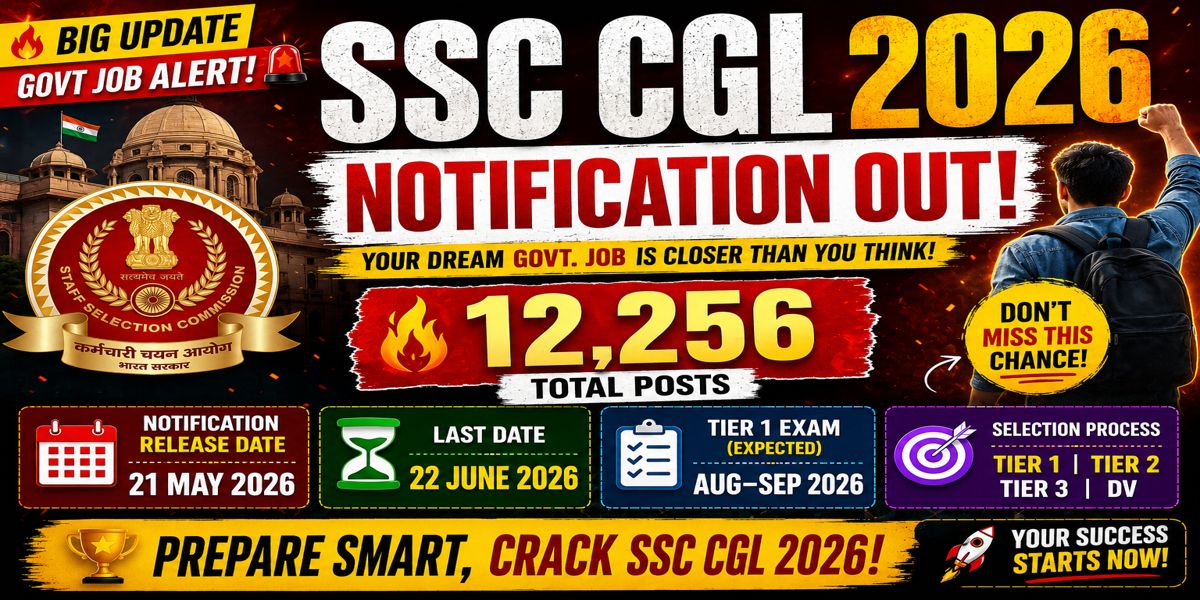
SSC CGL 2026 notification out for 12256 posts

The wait is officially over! The Staff Selection Commission has dropped the mega bomb of the year: the SSC CGL 2026 Notification is officially OUT on the new portal (ssc.gov.in). If you’ve been dreaming of securing a high-profile, powerful Central Government job with a handsome salary and authority, your countdown starts right now.

​This year, SSC has announced a massive 12,256 tentative vacancies for elite Group B and Group C posts, including Income Tax Inspectors, ASOs in MEA, Central Excise Inspectors, and CBI Sub-Inspectors.

But wait—before you hit that “Apply Online” button, there is a catch. The 2026 notification isn’t just a copy-paste of previous years. SSC has quietly slipped in some massive structural changes in eligibility, Tier-2 paper formatting, and strict administrative rules that could reject your application or tank your score if you aren’t paying attention.

​Let’s break down every critical detail, the hidden traps, and your strategic roadmap to crack SSC CGL 2026.


🚀 SSC CGL 2026: Master Schedule & Crucial Dates

​Do not wait until the final week. The SSC server is notorious for crashing due to heavy traffic. Mark these dates on your calendar immediately:

Notification Release Date: May 21, 2026

Online Application Window: May 21, 2026 to June 22, 2026 (Till 11:00 PM)

Last Date for Online Fee Payment: June 23, 2026 (Till 11:00 PM)

Application Correction Window: June 29, 2026 to July 1, 2026

SSC CGL Tier-1 Exam Date: August – September 2026

​SSC CGL Tier-2 Exam Date: December 2026 (Tentative)

⚠️ Pro-Tip for Readers: Set a personal deadline of June 15th to complete your online form submission. The correction window charges an extra fee, so get it right the first time!


🔗Important Links

Apply Online: Click here

SSC CGL 2026 Notification PDF: Click here

Official Website: https://ssc.gov.in/

Join WhatsApp Channel : Click here 

Join Telegram Channel: Click here


​🔥 The Major Bombshells: What Changed in SSC CGL 2026?

​If you are preparing based on the old rules, you are heading blindly into danger. SSC has updated its playbook this year. Here are the major changes you need to know:

Tier-II Exam Restructuring: The exam structure has evolved with a clear shift towards explicit sectional timelines. For the prestigious Assistant Audit Officer (AAO) and Assistant Accounts Officer tracks, a dedicated Paper-III evaluation layout has been introduced to filter out non-serious applicants early.

Statistical Investigator Criteria Explodes: Earlier, this post was locked down for pure Statistics grads. This year, eligibility has expanded massively! If your graduation includes fields like Data Science, Artificial Intelligence (AI), Computer Science, or Information Technology (IT), you can now apply.

The 3-Year Document Trap: Under the new administrative rules, candidates are strictly instructed to preserve their dynamic application records, identity authentications, and certificates for up to 3 years from the date of the exam. Do not lose your registered printouts!

Age Reference Shift: The crucial date for determining your eligibility age limit has been fixed as August 1, 2026.


💰 Post Profiles, Pay Levels & Vacancy Trends

​Why is there so much hype around the Combined Graduate Level exam? It is all about the power, stability, and jaw-dropping salary packages. Let’s look at the elite posts available under the 12,256 vacancies announced this year:

Pay Level 8 (Rs. 47,600 to Rs. 1,51,100): Assistant Audit Officer, Assistant Accounts Officer (The only Gazetted posts).

Pay Level 7 (Rs. 44,900 to Rs. 1,42,400): Inspector of Income Tax, Inspector (Central Excise), Assistant Section Officer (ASO) in MEA, IB, and CSS.

Pay Level 6 (Rs. 35,400 to Rs. 1,12,400): Sub-Inspector in CBI, Junior Statistical Officer (JSO), Divisional Accountant.

Pay Level 4 & 5 (Rs. 25,500 to Rs. 92,300): Auditor, Accountant, Tax Assistant, Senior Secretariat Assistant.


📉 Looking at the Reality Check: Vacancy Trends Over the Years

​While 12,256 is an incredible number, it is slightly lower than last year. This means competition will be razor-sharp. There is absolutely no room for casual preparation.

2026: 12,256 vacancies

2025: 15,118 vacancies

2024: 17,727 vacancies

2023: 8,415 vacancies


🎯 Cracking the Code: The Exam Pattern Explained

​The recruitment process consists of two primary online testing phases: Tier-1 and Tier-2, entirely eliminating the old interview system.

1. Tier-1 Examination (Qualifying Nature)

​You have 60 minutes to tackle 100 questions. Remember, there is a penalty of 0.50 marks for every wrong answer.

General Intelligence & Reasoning: 25 Questions (50 Marks)

General Awareness: 25 Questions (50 Marks)

Quantitative Aptitude: 25 Questions (50 Marks)

English Language & Comprehension: 25 Questions (50 Marks)


2. Tier-2 Examination (The Ultimate Merit Maker)

​This is where your final ranking is decided. It is broken down into separate mandatory modules:

Section I: Mathematical Abilities (30 Qs) + Reasoning & General Intelligence (30 Qs) — Time: 1 Hour

Section II: English Language (45 Qs) + General Awareness (25 Qs) — Time: 1 Hour

Section III: Computer Knowledge Module (20 Qs) + Data Entry Speed Test (DEST) — Qualifying but mandatory


​🛠️ Ultimate Checklist: How to Fill the Application Without Getting Rejected

​Every year, thousands of brilliant aspirants see their dreams shattered before the exam even starts because their application gets rejected. Avoid their mistakes by following this checklist:

​Mandatory Aadhaar Authentication: Ensure your mobile number is updated and linked with your Aadhaar for flawless authentication on ssc.gov.in.

​The Live Photo Rule: SSC no longer allows old uploaded photographs. You will need a clean webcam or mobile front-camera setup to capture a crisp, well-lit live photograph with a plain background. No caps, no spectacles, and look straight!

​EWS Certificate Validity: If applying under the Economically Weaker Section category, your financial certificate must be valid for the current Financial Year 2026-27.

​Application Fee: General, OBC, and EWS candidates need to pay a nominal fee of Rs. 100. SC, ST, PwBD, ESM, and all Female candidates are entirely exempted from the fee.


​How to Apply for SSC CGL 2026: Complete Step-by-Step Guide


The Staff Selection Commission (SSC) has officially released the notification for 12,256 vacancies across Group B and Group C posts. Candidates looking to apply must navigate a dual-platform process involving the new official portal and the newly launched mobile application.


Phase 1: One-Time Registration (OTR)

Every candidate must complete the new OTR on the updated portal. Old registration IDs from the legacy website are no longer valid.


Step 1: Visit the New Portal

Navigate to the official portal at ssc.gov.in. Click on the ‘Login or Register’ link on the top right and select ‘Register Now’.


Step 2: Provide Personal Identity Details

Fill in basic identification credentials. This includes your Name, Father’s Name, Mother’s Name, and Date of Birth exactly as recorded on your Class 10th Matriculation certificate.


Step 3: Complete Aadhaar Authentication

Enter your 12-digit Aadhaar number to trigger an OTP authentication on your registered mobile number. (Note: If a candidate does not have Aadhaar, they must manually upload an alternative valid Government ID like a PAN or Passport).


Step 4: Generate OTR Credentials

Fill in your category details, contact address, and highest educational background. Set up a strong, unique password along with your selected security questions to generate your official Registration ID.


Phase 2: Filling the Examination Form

After the OTR profile is generated, the candidate can log in to directly submit their exam application.


Step 5: Login to the Dashboard

Sign in to ssc.gov.in using your freshly generated Registration ID and password. Solve the CAPTCHA code to access your candidate dashboard.


Step 6: Initiate CGL Application

Look under the ‘Latest Notifications’ section. Locate the Combined Graduate Level Examination 2026 listing and hit ‘Apply’. Your OTR profile data will auto-populate the layout.


Step 7: Set Exam Center Preferences

Select three exam centers in order of personal preference within your chosen SSC region. Confirm if you meet the specific educational benchmarks for specialized posts (like Junior Statistical Officer).


Step 8: Capture Live Photo via Mobile

Crucial Step: The portal no longer accepts pre-shot passport photos. Candidates must download the official ‘mySSC’ app from the Google Play Store or Apple App Store. Log into the app, launch the camera tool, stand before a clean, light background without a cap, spectacles, or mask, and snap a real-time photo.


Step 9: Upload Signature & Pay Fee

Upload a scanned signature file in JPEG/JPG format (10 KB to 20 KB). Preview the form carefully, pay the Rs.100 fee via UPI, Net Banking, or Credit/Debit card, and download your final submission confirmation PDF. (Women, SC, ST, PwBD, and Ex-Servicemen are fully exempt from this payment).


Blog Note to Reader: Remind your readers that corrections made during the June 29 – July 1 window attract an processing fee of Rs.200 for the first modification and Rs.500 for a subsequent attempt. It’s best to verify structural details during the initial setup!


💡 Game Plan: How to Prepare for Tier-1 (August – September 2026)

​With roughly 3 months left for the Tier-1 exam, your preparation strategy needs an immediate upgrade:

​Prioritize High-Yield Quant Topics: Master Geometry, Algebra, Percentage, and Profit & Loss. Speed is your currency in Tier-1.

​Do Not Ignore General Awareness: This is the ultimate differentiator. Dedicate an hour daily to the last 8-10 months of Current Affairs and core Static GK subjects (History, Indian Polity, and General Science).

​Mock Test Ritual: Start taking 2 full-length sectional mock tests every week. Analyze your mistakes meticulously; an unanalyzed mock test is a wasted mock test.

​Are you ready to claim your seat in the Central Government ministries this year? Don’t let this opportunity slip away. Drop a comment below if you face any issues while filling out the form, and share this post with your fellow aspirants to kickstart your preparation together!


📚SSC CGL 2026 Syllabus: Tier 1 Detailed Subject-Wise Topics

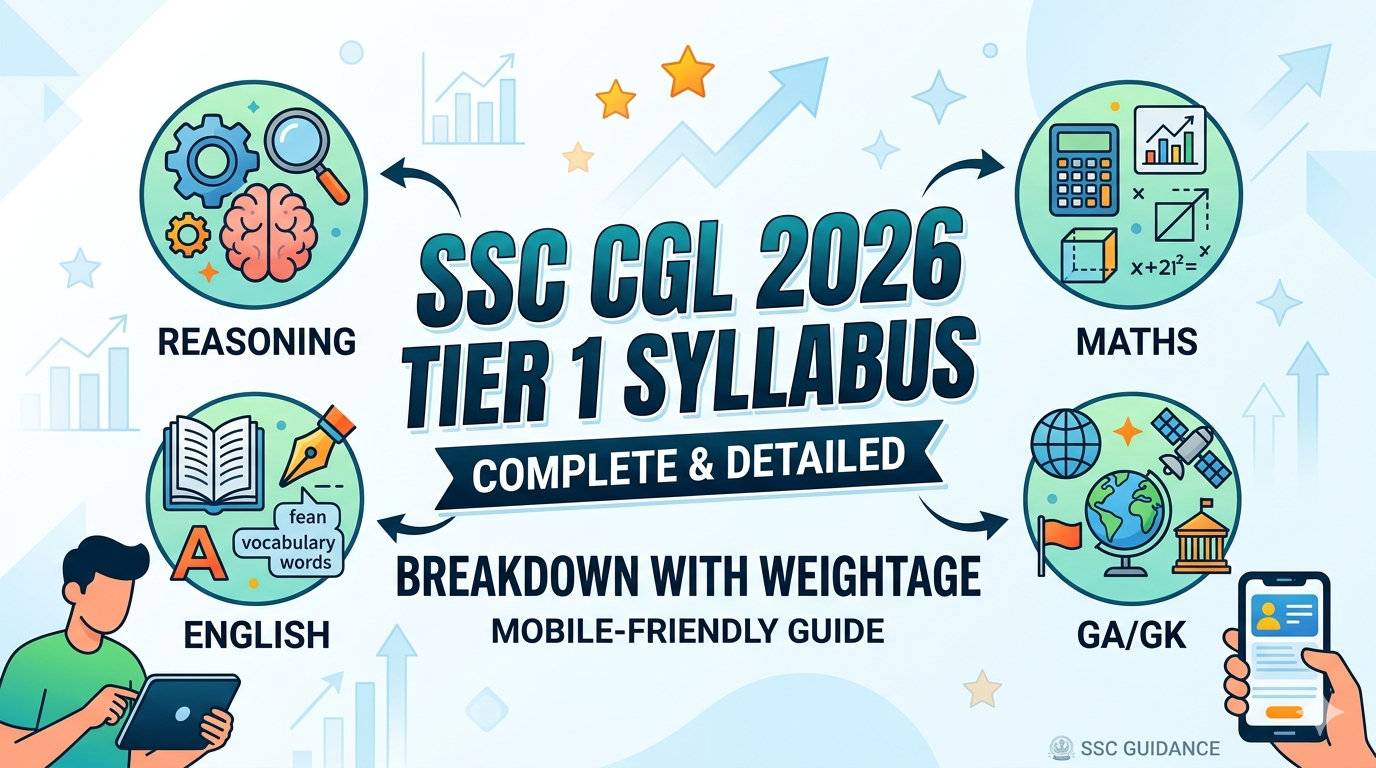
Infographic showing SSC CGL 2026 Tier 1 Syllabus with subject-wise marks weightage for Maths, Reasoning, English, and GK.

✍️Intro

The Staff Selection Commission Combined Graduate Level (SSC CGL) exam is one of the most competitive government exams in India.

Every year, lakhs of candidates apply—but many fail not because the exam is tough, but because they don’t understand the syllabus properly.

In this article, you’ll get a complete and detailed SSC CGL syllabus, along with a clear understanding of what to study and how to prepare effectively.

🟢 SSC CGL Tier 1 Exam Pattern

SUBJECT No. of QuestionsMarks
General Intelligence & Reasoning 25 50
General Awareness 25 50
Quantitative Aptitude 25 50
English Comprehension 25 50
Total 100 200

🕒 Time: 60 Minutes

📝 Note: 20 Extra for PwBD

Negative Marking: 0.50 marks per wrong answer


1. 🧠 General Intelligence & Reasoning (50 Marks)

This section tests your logic. It is usually the highest-scoring part of the exam.

TopicExpected QuestionsPriority
Analogy (Letter, Number, Image) 3 – 4 Very High
Classification (Odd One Out) 2 – 3 High
Series (Number & Alphabet) 2 – 3 High
Coding-Decoding 2 – 3 High
Non-Verbal (Mirror/Water Image, Paper Folding) 3 – 5 Very High
Mathematical Operations (Sign Change) 2 Medium
Blood Relations 1 – 2 Medium
Syllogism & Venn Diagrams 2 Medium
Direction Sense 1 Low
Missing Numbers/Matrix 1 – 2 Medium
Dictionary Order/Word Formation 1 Low

👉 Tip: Practice daily — this section is scoring but tricky


2. 🌍 General Awareness /GK (50 Marks)

Very broad. Focus on the last 6–9 months of news and science.

TopicExpected QuestionsPriority
Current Affairs (Last 6-9 Months) 5 – 7 Very High
Static GK (Dance, Music, Awards, Sports) 4 – 6 Very High
History & Culture 3 – 4 High
General Science (Biology, Physics, Chemistry) 3 – 5 High
Polity & Constitution 2 – 3 Medium
Geography (Rivers, Dams, Maps) 2 Medium
Economics 1 – 2 Low


3. 🔢 Quantitative Aptitude (50 Marks)

Focus on speed. Arithmetic carries more weight, but Advanced Maths is the tie-breaker.

TopicExpected QuestionsPriority
Data Interpretation (Bar, Pie, Table) 4 – 5 Very High
Geometry (Triangles, Circles) 3 – 4 Very High
Mensuration (Area, Volume) 2 – 3 High
Trigonometry (Identities, Heights) 2 – 3 High
Algebra (Basic Identities) 2 – 3 High
Ratio, Proportion & Percentage 2 – 3 High
Profit, Loss & Discount 2 Medium
Time, Speed & Distance / Work 2 Medium
Number System & Simplification 1 – 2 Medium
Interest (SI & CI) 1 – 2 Medium
Averages & Mixtures 1 Low

👉 This is the most time-consuming section — practice is key


4.📝 English Language & Comprehension (50 Marks)

The fastest section to solve. Accuracy in grammar is key.

TopicExpected QuestionsPriority
Cloze Test (Paragraph with blanks) 5 Very High
Error Spotting 3 – 4 Very High
Synonyms & Antonyms 3 – 4 Very High
Idioms & Phrases 2 – 3 High
One-Word Substitution 2– 3 High
Sentence Improvement 2 Medium
Active/Passive & Direct/Indirect 2 Medium
Spelling Correction 1 – 2 Low
Para-jumbles (Sentence Reordering) 1 – 2 Low

👉 Strong English can boost your rank quickly


⚠️ Important: SSC does NOT officially provide weightage.

This is based on previous year papers analysis.


🚀 Reality Check

SSC doesn’t ask “out of syllabus” questions.

  • Speed ⏱️
  • Accuracy 🎯
  • Concept clarity 🧠

🎯 How to Prepare Using SSC CGL Syllabus

  • Don’t try to study all topics at once
  • First focus on Maths + Reasoning basics
  • Revise GK daily (small portions)
  • Practice previous year questions topic-wise
  • Take mock tests weekly
🔥 Final Words

Understanding the syllabus is the first step—but success depends on consistent practice and smart strategy.

If you follow the syllabus properly, SSC CGL is absolutely crackable.


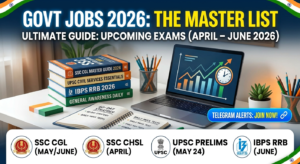
Ultimate Guide: Upcoming Government Exams (April – June 2026) & The Road to Success

Introduction: Why 2026 is Your Year for a Government Career

The next 90 days are a “Golden Window” for government job aspirants in India. With major recruitment cycles from SSC, UPSC, and Banking (IBPS) aligning between April and June, over 50,000+ vacancies are expected to be announced. Whether you are a final-year student or a working professional, the “Mission 2026” starts now. This guide breaks down every major notification, syllabus secret, and a day-by-day preparation strategy to ensure you don’t just “apply,” but “get selected.”

1. The Mega Exam Calendar (Q2: April – June 2026)

This is the heart of your search. Use this table to track your targets.

Exam BodyPost /RecruitmentExpected NotificationTentative Exam DateVacancy (Est.)
SSC CGL 2026 (Group B & C) May 2026 Aug – Sept 2026 12,000+
SSC CHSL (10+2 Level) April 2026 July 2026 4,500+
UPSC Civil Services (Prelims) Completed May 24, 2026 1,000+
IBPS PO & Clerk June 2026 Aug 2026 8,000+
Railways ALP / Technician Ongoing June 2026 15,000+
UPSC CAPF (AC) April 2026 August 2026 300+
SSC Stenographer April 30, 2026 Aug – Sept 2026 2,000+

2. Master Syllabus Breakdown

Most exams follow a “Big Four” pattern. If you master these, you can sit for 80% of all Govt exams:

  1. Quantitative Aptitude: Focus on Arithmetic (Percentage, Profit & Loss) and Data Interpretation.
  2. Reasoning Ability: Master Puzzles, Syllogism, and Blood Relations.
  3. English Language: Grammar basics, Cloze Test, and Reading Comprehension.
  4. ​General Awareness: Focus on the last 6 months of Current Affairs and “Static GK” (History/Polity).

3. The “0 to Selection” 60-Day Prep Strategy 

  • ​Phase 1 (Days 1-30): The Foundation. Finish all NCERT basics (Class 6-10) for GS and clear your concepts in Math/Reasoning.
  • ​Phase 2 (Days 31-50): Speed & Accuracy. Start solving “Sectional Tests.” Don’t do full mocks yet; focus on one subject at a time.
  • ​Phase 3 (Days 51-60): The Mock Marathon. Take one full-length mock test every day at the exact time your real exam will be held. Analyze your mistakes for 2 hours after each test.
4. The Final Word: Your Journey Starts with One Step 

​The difference between an aspirant and a selected officer isn’t just talent—it’s consistency. While thousands will read this notification list, only a few will open their books tonight.

The 2026 exam season is a massive opportunity to secure your future, gain financial independence, and serve the nation. Don’t wait for the “perfect time” or the “official admit card.” The syllabus is vast, but your determination is stronger. Whether it’s mastering that one difficult Math formula or memorizing the last six months of Current Affairs, every hour you put in now is a deposit into your future success.

Believe in the process. Stay disciplined. Your name is waiting to be on that final merit list.

Strategic Call to Action (CTA)

​🚀 Don’t Miss a Single Update!

​Government timelines change fast. To ensure you never miss a deadline, a syllabus change, or a result announcement:

  • Subscribe to our Newsletter: Enter your email below to get a weekly summary of “High-Priority” jobs delivered straight to your inbox.
  • Join our WhatsApp Channel: Get instant alerts on your phone for daily quizzes, PDF notes, and 2026 Exam Alerts. [Click here to Join]
  • Bookmark This Page: Hit Ctrl + D now. We update this table every Monday with the latest news from SSC, UPSC, and State Boards.